


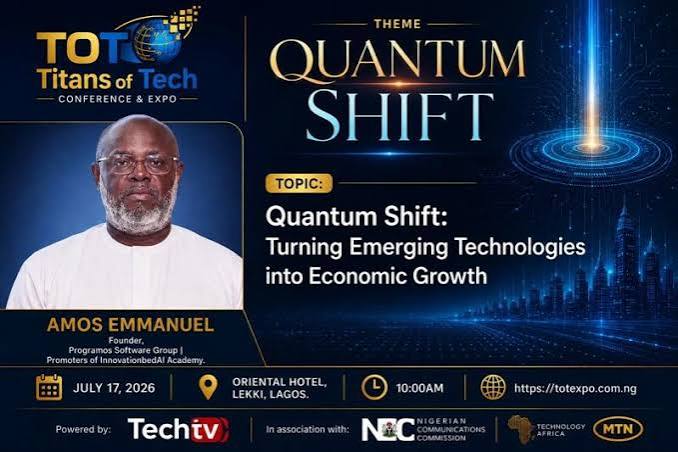
Artificial intelligence, quantum computing and other emerging technologies will only deliver meaningful economic growth if organisations invest in people, leadership and data-driven cultures, according to Amos Emmanuel, innovation advocate and Titans of Tech 2026 keynote speaker.

Speaking during the Titans of Tech Conference and Expo 2026, themed “Quantum Shift: Turning Emerging Technologies into Economic Growth,” Emmanuel said businesses and governments must move beyond the excitement surrounding new technologies and focus on building the human capabilities required to translate innovation into measurable economic outcomes.
“The real transformation is not about technology alone. It is about people, strategy and culture,” he said, stressing that many digital transformation initiatives fail because organisations adopt sophisticated technologies without developing the skills and organisational mindset needed to maximise their value.
Drawing on the views of data literacy expert Jordan Morrow, Emmanuel noted that technology does not create data-driven organisations on its own.
“People do,” he said, explaining that competitive advantage increasingly depends on an organisation’s ability to build data literacy, encourage innovation and foster continuous learning across its workforce.
According to him, the conference theme reflects a broader business transformation rather than simply advances in quantum computing.
He described the “quantum shift” as a fundamental change in organisational thinking, where emerging technologies such as artificial intelligence become integral to business strategy, operations and decision-making rather than isolated technology projects.
“This requires bold leadership willing to rethink traditional ways of working and embed innovation into the DNA of organisations,” he said.
Emmanuel argued that emerging technologies must be deployed to solve practical economic and social challenges rather than being adopted simply because they are fashionable.
He highlighted AI’s potential to transform healthcare, financial services and agriculture, while noting that quantum computing could unlock breakthroughs in logistics, cybersecurity and pharmaceutical research.
“The goal should never be innovation for innovation’s sake,” he said. “The objective must always be economic impact.”
He also underscored the importance of collaboration among governments, regulators, technology companies, startups, academia, investors and the media in accelerating digital transformation.
According to him, industry platforms such as the Titans of Tech Conference provide opportunities for stakeholders to exchange ideas, establish common standards and develop partnerships capable of driving innovation at scale.
“Innovation thrives within ecosystems, not silos,” Emmanuel said.
He advised organisations to begin their digital transformation journeys by assessing their current level of digital and data maturity before investing heavily in new technologies.
Businesses, he said, should identify gaps in skills and infrastructure, focus on solving high-impact business challenges and scale successful initiatives gradually instead of pursuing numerous disconnected projects.
He further described education as the foundation of Africa’s digital future, calling for sustained investments in workforce development, data literacy, critical thinking and adaptability.
“Technology evolves rapidly, but skills must evolve even faster,” he said.
Emmanuel also identified leadership as the decisive factor in successful digital transformation, urging executives to articulate clear visions, empower employees and promote evidence-based decision-making supported by data.
Without a culture that encourages innovation, experimentation and continuous learning, he warned, even the most advanced technologies would struggle to generate meaningful business value.
Looking ahead, Emmanuel said Africa stands at a defining moment in its digital journey.
With one of the world’s youngest populations and rapidly expanding digital adoption, he said the continent has an opportunity to leverage emerging technologies to accelerate industrialisation, create jobs and diversify its economies.
However, he maintained that Africa’s long-term success will depend less on acquiring cutting-edge technologies than on developing the human capacity to deploy them effectively.
“The future belongs not to those with the most advanced technologies, but to those who know how to use them to solve real problems,” Emmanuel said.
“The quantum shift is not merely about adopting new technologies. It is about transforming how people think, learn, lead and innovate to create lasting economic prosperity.”

