


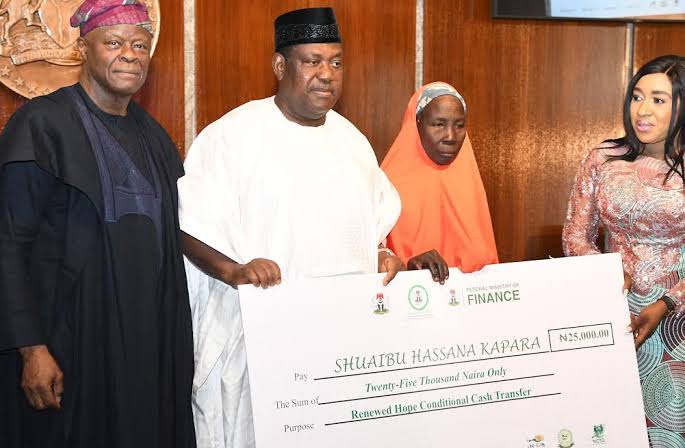
The Federal Government’s decision to introduce a monthly ₦50,000 cash transfer for vulnerable households offers a measure of relief at a time when millions of Nigerians are struggling with rising living costs. But while the intervention is welcome, its capacity to make a meaningful difference to the country’s poverty crisis will depend on how many people benefit, how long the payments last and whether the programme addresses the structural causes of hardship.

Announcing the initiative on October 30, 2026, Bernard Doro, Minister of Humanitarian Affairs, said the government had commenced the National Economic Recovery and Social Intervention (NERSI) cash relief programme. Under the arrangement, eligible households will receive ₦50,000 monthly through bank accounts or mobile wallets.
The minister said beneficiaries would be contacted through licensed digital financial service providers. Payments would be made with the beneficiaries’ consent, while applicants would not be required to pay fees or engage agents to access the support. The government also provided a helpline, 0700-022-2222, for enquiries.
The announcement is significant. For households whose incomes have been eroded by inflation, higher transport costs, food prices and other essential expenses, a predictable cash payment can help meet immediate needs. It could provide breathing space for families forced to make difficult choices between food, healthcare, education and other necessities.
Yet the announcement also raises important questions. Is ₦50,000 enough to provide meaningful support in today’s economy? How many households will receive it? For how long will payments continue? And what safeguards will ensure that the money reaches the people who need it most?
These are not minor administrative details. They will determine whether NERSI becomes a credible social protection intervention or another government announcement whose impact is difficult to measure.
The first challenge is the value of the payment. At ₦50,000 a month, the intervention may help a household purchase food, pay part of its transport costs or cover other pressing expenses. But the purchasing power of that amount depends on household size, location and prevailing prices.
A family of two in a rural community faces a different cost structure from a household of six in Lagos or Abuja. A uniform payment may therefore offer unequal levels of support, even when beneficiaries have similar income profiles.
The government should explain the basis for choosing ₦50,000 and whether the amount will be reviewed as prices change. The minister’s indication that the payment will undergo periodic review is encouraging, but the public needs clarity on the review mechanism and the indicators that will guide adjustments.
Cash transfers are useful because they give recipients flexibility to decide how best to spend the money. However, their effectiveness diminishes when the amount is too small to meet basic needs or when payments are irregular.
Perhaps the most important unanswered question concerns the number of beneficiaries. Nigeria has a large population of poor and economically vulnerable people. Without a clear target, it is difficult to assess the scale of the intervention or determine whether it is proportionate to the challenge.
The World Bank reported that ₦658.9 billion had been disbursed in cash transfers to 10.46 million poor and vulnerable households by September 2026. That figure provides useful context, but it also highlights the need for the government to explain how NERSI relates to existing social protection programmes.
Will the new initiative expand the number of beneficiaries, replace an existing programme or operate alongside current transfers? How will the government prevent duplication and ensure that households already receiving assistance are treated fairly?
The administration should publish the programme’s eligibility criteria, beneficiary targets, funding arrangements and implementation timetable. It should also disclose the total budget and the expected cost of sustaining monthly payments.
Transparency is essential because social intervention programmes are particularly vulnerable to political interference, weak targeting, inflated beneficiary records and diversion of funds. Independent monitoring and regular public reporting would help build confidence.
The decision to use licensed digital financial service providers could improve payment efficiency and reduce the involvement of intermediaries. Direct transfers also create transaction records that can support monitoring and accountability.
However, digital delivery does not automatically guarantee inclusion. Some vulnerable Nigerians have limited access to smartphones, reliable networks, bank accounts or the documentation required to complete financial transactions.
The government must ensure that people are not excluded because of technological barriers. A functioning complaints and grievance-redress system will also be necessary for beneficiaries who experience failed payments, incorrect records or difficulties accessing their funds.
The warning against paying application fees or dealing with unauthorised agents is important. But it should be reinforced through sustained public communication, monitoring and swift action against fraudsters.
There is a broader issue that the government must not overlook. Cash transfers can reduce immediate hardship, but they cannot independently resolve the conditions that keep households poor.
Nigeria’s poverty challenge is connected to weak job creation, low productivity, inadequate infrastructure, limited access to affordable finance and the vulnerability of millions of informal-sector workers. These problems require sustained economic and institutional reforms.
A family receiving ₦50,000 monthly may be better able to cope with food expenses, but the payment does not necessarily create a sustainable source of income. If the support stops without an improvement in household earnings, beneficiaries may return to the same difficult circumstances.
The World Bank has consistently emphasised the importance of expanding the coverage, adequacy and consistency of social protection, supported by reliable budget provisions and a sustainable delivery system. That advice should inform the design of NERSI.
The government should connect social assistance with practical pathways to economic participation. Skills development, access to productive assets, support for small businesses and opportunities for decent work can help vulnerable households move beyond dependence on periodic transfers.
This is particularly important for young people and working-age adults who need opportunities to earn, not simply temporary relief.
Ultimately, NERSI should be judged by outcomes, not the announcement. The government must demonstrate that payments are regular, beneficiaries are properly selected and public funds are accounted for.
It should also publish measurable targets: the number of households to be reached, the duration of support, the programme’s cost and the indicators that will be used to evaluate its impact on poverty and household welfare.
Nigeria needs an effective social protection system. For millions of households facing economic pressure, ₦50,000 could make a difference. But the value of the intervention will be determined by its reach, reliability and ability to complement wider economic reforms.
The government has taken a step in the right direction. The real test is whether it can turn that announcement into sustained, transparent and measurable support.
Cash transfers can cushion the poor against economic shocks. They cannot, on their own, build an economy in which fewer people need relief in the first place.

