President Bola Tinubu has proposed a ₦58.47 trillion 2026 budget that places security, health and human capital development at the heart of Nigeria’s fiscal priorities.

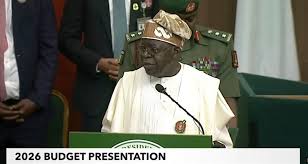
Presenting the Appropriation Bill, titled “Budget of Consolidation, Renewed Resilience and Shared Prosperity”, to a joint session of the National Assembly on Friday, Tinubu proposed ₦5.41 trillion for defence and security, the single largest sectoral allocation, and ₦2.48 trillion for health.
Infrastructure is allocated ₦3.56 trillion, while education receives ₦3.52 trillion.
Tinubu said the spending plan reflects the Renewed Hope Agenda and is structured as a “coherent programme of national renewal.”
“Without security, investment will not thrive. Without educated and healthy citizens, productivity will not rise. Without infrastructure, jobs and enterprise will not scale,” he told lawmakers.
Security spending will focus on modernising the Armed Forces, intelligence-led policing, joint security operations, technology-enabled border surveillance, and community-based peacebuilding initiatives.
The president described health and education spending as critical to boosting productivity, economic resilience, and long-term growth.
The 2026 budget is anchored on the 2026–2028 Medium-Term Expenditure Framework (MTEF), with assumptions of a $64.85 per barrel oil benchmark, production of 1.84 million barrels per day, and an exchange rate of ₦1,400 to the dollar.
Tinubu also announced an end to the practice of running overlapping budgets, pledging that all concurrent budgets would be concluded by March 2026.
“There will no longer be the rolling over of budgets from March 2026,” he said.
The Federal Executive Council had earlier approved the budget and MTEF amendments. The Senate approved the framework earlier in the week, while the House of Representatives followed on Thursday.
The budget presentation was attended by Vice President Kashim Shettima, top government officials, lawmakers and state governors.