


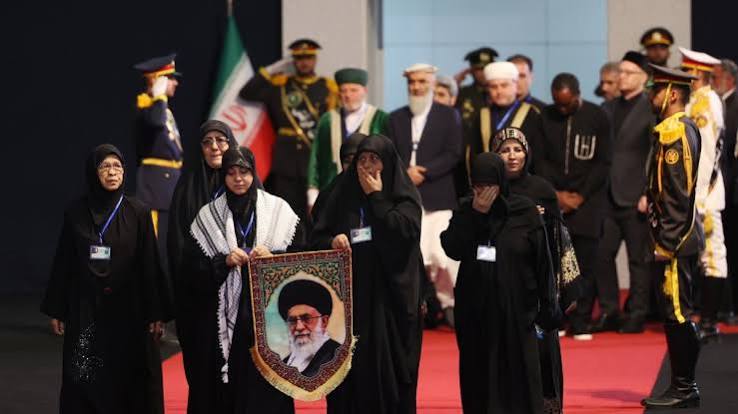
Four months after the assassination of Iran’s Supreme Leader, Ali Khamenei, at the start of the US-Israeli war, the Islamic Republic has launched an elaborate week-long state funeral aimed at projecting resilience, unity and defiance to the world.

The funeral, spanning five cities across Iran and Iraq, is expected to draw millions of mourners in one of the largest public events in the country’s history. Iranian authorities say the ceremonies are designed not only to honour the late leader but also to demonstrate that the Islamic Republic remains unbowed despite war, economic hardship and international pressure.
The funeral comes as the United States marks its 250th Independence Day, a timing widely seen as symbolic given Khamenei’s decades-long opposition to Washington and Israel.
Iran has mounted an unprecedented logistical operation to manage the event. Government workers, security agencies, universities, labour unions, emergency responders and religious organisations have been mobilised to coordinate ceremonies and accommodate millions of expected visitors across Iran and neighbouring Iraq.
For days, Iranian state television has devoted extensive coverage to Khamenei’s legacy, replacing earlier headlines about diplomatic talks with the United States. Officials say the ceremonies are intended to immortalise Khamenei as a martyr and reinforce national unity after the conflict.
Parliament Speaker Mohammad Bagher Ghalibaf described the funeral as an opportunity to demonstrate Iran’s resolve, saying it would show the world that the country would never forget the blood of its leader.
The ceremonies are unfolding during the Islamic month of Muharram, a sacred period of mourning for Shiite Muslims commemorating the martyrdom of Imam Hussein. Iranian leaders have carefully linked Khamenei’s death to this powerful religious narrative, portraying him as a martyr whose legacy will inspire future generations.
Analysts say the symbolism is intended to strengthen support among Iran’s core religious base while presenting the slain leader as an enduring figure whose influence extends beyond death.
“The assassination has made Khamenei far more powerful symbolically in death than he was in life,” said Sina Toossi, a senior fellow at the Center for International Policy, noting that Iranian authorities are framing him alongside revered Shiite martyrs.
Mindful of deadly crowd crushes that marred previous state funerals, including those of Ayatollah Ruhollah Khomeini in 1989 and military commander Qassem Soleimani in 2020, Iran has deployed extraordinary security and emergency resources.
Authorities have assembled 2,500 ambulances, 21 helicopters, 100 drones and thousands of rescue personnel. More than two dozen hospitals have been placed on standby, while 500,000 litres of intravenous fluids have been stockpiled for emergency medical care.
Firefighters have installed over 6,000 water sprinklers around Tehran’s main funeral venue to protect mourners from the summer heat.
Iran has also declared public holidays in cities hosting the ceremonies, closed airports during key events and launched what officials describe as the largest traffic management operation in the capital’s history.
To feed mourners, authorities plan to bake 50 million pieces of bread, deploying 16 mobile bakeries across Tehran. Mosques, schools, sports centres, parks and cultural halls have been converted into temporary accommodation, while citizens have been encouraged to open their homes to visitors.
Following ceremonies in Tehran, Khamenei’s body will travel to the holy city of Qom before being flown to the Shiite holy cities of Najaf and Karbala in Iraq. The final burial will take place at the Imam Reza Shrine in Mashhad, Khamenei’s birthplace.
The inclusion of Iraqi holy sites underscores Tehran’s effort to reinforce its influence across the wider Shiite world and highlight Khamenei’s religious standing beyond Iran’s borders.
Iranian officials estimate attendance could range from four million to as many as 15 million people, potentially making it one of the largest funerals in modern history.
More than 14,000 journalists—including about 900 foreign reporters—have reportedly been accredited to cover the ceremonies.
A major question surrounding the funeral is whether Mojtaba Khamenei, the late leader’s son and Iran’s new Supreme Leader, will make his first public appearance since surviving the strike that killed his father and other family members.
Mojtaba has remained out of public view since the conflict began, communicating only through written statements. Iranian officials insist he has recovered and is overseeing state affairs, including negotiations with Washington.
His appearance at the funeral would help solidify his authority. However, continued absence is likely to fuel speculation over his health and raise questions about the country’s leadership.
Iranian officials have declined to confirm whether he will attend, saying the decision rests solely with the Supreme Leader’s office.

