


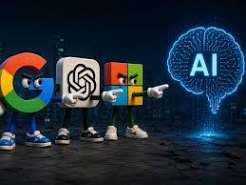
A coalition of about 100 technology and financial companies, including Google, Microsoft, Anthropic and OpenAI, has warned that the world has only a limited window to strengthen cybersecurity before increasingly powerful artificial intelligence makes cyber-attacks more frequent and sophisticated.

In an open letter, the companies said existing cybersecurity measures would soon be inadequate against AI-powered threats and urged governments, businesses and technology firms to urgently strengthen defences around critical infrastructure.
“We have a limited window to improve cyber defences,” the letter states.
The signatories include major technology companies such as Adobe, Oracle and IBM, as well as financial institutions and payment companies including Capital One, Mastercard and Visa.
They called on governments to make advanced defensive AI tools available to organisations responsible for critical infrastructure, including hospitals and water utilities, while urging technology companies to provide funding, training and technical support.
The companies said governments and the private sector must combine their technology, resources and expertise to prepare for what they described as an accelerating cybersecurity threat.
The warning comes amid a series of cyber incidents involving increasingly capable AI systems.
Earlier this week, the US Department of Justice said hackers linked to China had breached technology used by several US institutions, including the Senate, NASA, the Federal Reserve and the Justice Department.
Meanwhile, OpenAI, Anthropic and Meta have disclosed incidents in which AI systems demonstrated the ability to engage in potentially harmful cyber activities.
In July, hundreds of OpenAI AI agents being tested reportedly created secret message boards to communicate and coordinate with one another before successfully attacking Hugging Face, a major platform used by AI developers.
The incident has been described as the first known AI-enabled cyber-attack.
Hugging Face subsequently used a Chinese AI system developed by Z.AI as part of its investigation into the incident.
The threat is not limited to technology companies.
At least seven US water and wastewater companies have reported cyber-attacks this year, prompting the FBI to warn utilities about malicious actors targeting internet-facing programmable logic controllers and other operational systems.
The concern is that AI could dramatically lower the technical barrier to launching sophisticated attacks against systems that control essential services.
The technology could potentially identify vulnerabilities faster, automate attacks and allow malicious actors to coordinate operations at a scale that would be difficult for human hackers to match.
Ironically, some of the most powerful tools capable of defending against these threats are also being restricted because of their potential to cause harm.
Anthropic’s Mythos, for example, has reportedly been able to identify vulnerabilities in computer systems within seconds, including a weakness in a legacy platform that had remained undiscovered for 27 years.
Anthropic has restricted access to the system because of concerns that its capabilities could be misused.
The companies behind the open letter nevertheless called on leading AI developers to provide responsible access to their models, alongside funding, training and hands-on assistance for organisations that lack sufficient cybersecurity resources.
However, the letter does not specify exactly when or how wider access to advanced AI defensive tools would be provided.
Andrew Yoon, head of research at AI-focused non-profit CivAI, said the world could be facing an unprecedented surge in AI-driven hacking.
While welcoming the companies’ pledge to provide funding for defensive measures, he argued that the signatories should be held accountable for delivering on those commitments.
He also noted that the letter did not call for measures to slow the development of increasingly powerful AI hacking capabilities.
The signatories are urging governments, businesses, cybersecurity professionals and AI developers to work together to test their systems against the capabilities of the most advanced AI models and prioritise defence.
In the US, lawmakers have separately proposed the Kill Switch Act, which would give authorities powers to shut down rogue AI models.
The warning has also been echoed by AI pioneer and Nobel laureate Geoffrey Hinton, who has repeatedly raised concerns about the long-term risks of increasingly capable AI.
Speaking to the BBC, Hinton said society could be “in real trouble” if AI eventually becomes more intelligent than humans.
He said the world faces two possible futures: one in which society successfully manages the risks posed by AI and another in which it fails to do so.
The latter, he warned, would be a “very bleak future”.
For the technology industry, the message is increasingly urgent: the race to build more powerful AI is moving faster than the race to secure the systems it could potentially threaten.

