
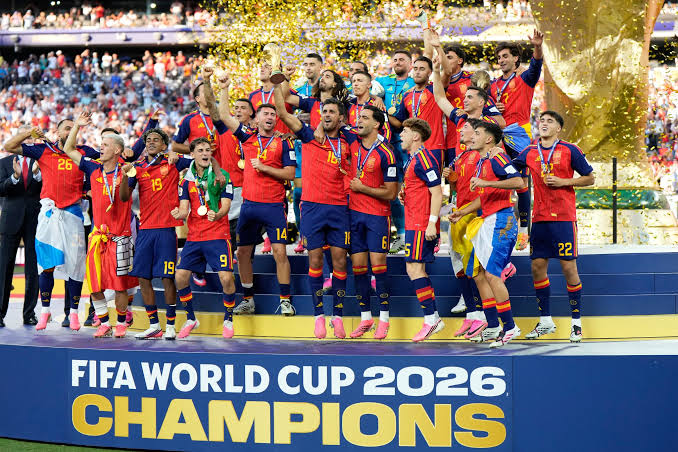
Spain crowned a remarkable FIFA World Cup campaign by defeating defending champions Argentina 1-0 after extra time in the 2026 final, producing a disciplined and tactically dominant display to lift their second world title.

Ferran Torres struck the decisive goal in the 106th minute at MetLife Stadium in New Jersey, capping a tournament in which Luis de la Fuente’s youthful side steadily grew into the competition before emerging as deserved champions.
The victory ended Argentina’s reign as world champions and marked another milestone for a Spanish team that has now gone 38 matches unbeaten while conceding just one goal throughout the tournament.
Spain arrived in North America with one of the tournament’s youngest squads, averaging just over 26 years of age. The gamble on youth paid off spectacularly.
Teenagers Lamine Yamal and Pau Cubarsí were central figures throughout the campaign, while Pedri, Nico Williams and Torres underlined the depth of Spain’s emerging generation.
Although Yamal scored only once during the tournament, the teenage sensation remained one of Spain’s most influential performers, featuring in every match and consistently troubling opposition defences. Torres finished the job by scoring the goal that secured football’s biggest prize.
Spain’s World Cup journey began on an uncertain note with a shock goalless draw against tournament debutants Cape Verde, raising doubts about their title credentials.
The European champions quickly found their rhythm, beating Saudi Arabia and Uruguay to progress from the group stage before eliminating Austria in the Round of 32.
The knockout rounds demanded greater resilience. Substitute Mikel Merino emerged as Spain’s unlikely hero, scoring late winners against Portugal and Belgium to keep La Roja’s title dream alive.
Spain’s success was built on tactical discipline and midfield superiority.
Their semifinal victory over France showcased the blueprint that would ultimately deliver the trophy. The midfield trio of Rodri, Dani Olmo and Fabián Ruiz controlled possession, dictated the tempo and denied France’s star-studded attack, including Kylian Mbappé, any meaningful influence.
The same formula proved decisive in the final.
Spain monopolised possession with 65 percent of the ball, patiently wearing Argentina down over 120 minutes. Lionel Scaloni’s side managed only two shots throughout the match and failed to register a single effort on target.
Argentina’s frustrations eventually boiled over late in normal time when Enzo Fernández received a second yellow card, reducing the defending champions to 10 men.
Spain capitalised during extra time as Torres fired emphatically into the roof of the net to seal a famous victory.
Having added the World Cup to their European Championship title, Spain appear well positioned to dominate international football for years to come.
With stars such as Yamal, Cubarsí, Pedri and Williams still years away from their peak, La Roja boast one of the strongest young cores in world football.
Head coach Luis de la Fuente, whose contract runs until 2028, has successfully blended youth with tactical discipline to build a team capable of sustained success.
Spain will now turn their attention to defending their European Championship crown before setting their sights on another World Cup challenge in 2030, when many of this golden generation will be entering their prime.