
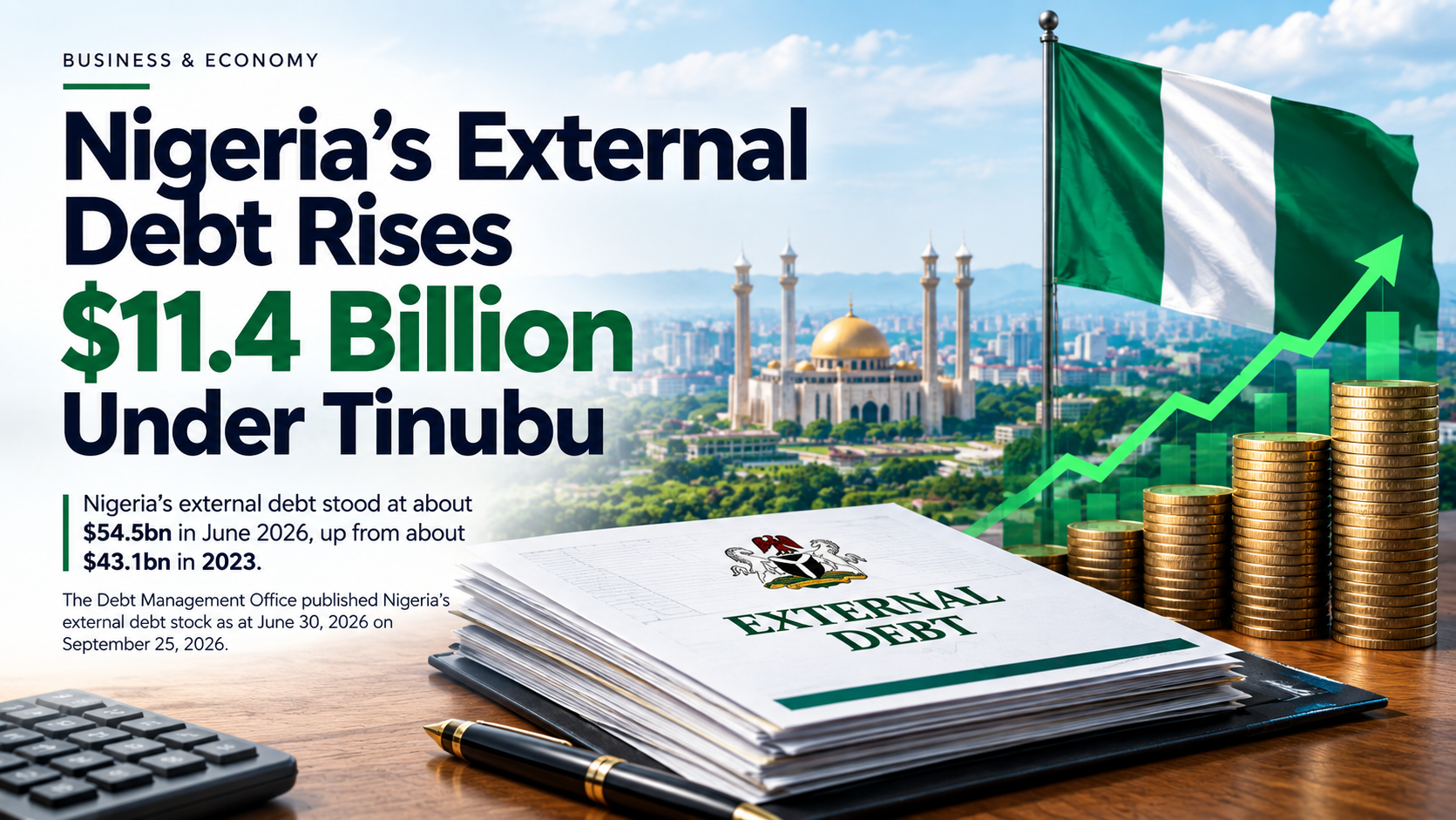
Nigeria’s external debt has increased by about $11.4 billion since President Bola Ahmed Tinubu assumed office, with fresh multilateral, commercial and syndicated financing adding to the country’s borrowing obligations.

Data reviewed by Nairametrics Research show that Nigeria’s total external debt stood at about $54.5 billion as of June 2026, compared with approximately $43.1 billion when Tinubu took office.
The increase has coincided with the Federal Government’s efforts to finance economic reforms, infrastructure and other spending commitments through a combination of multilateral loans, Eurobonds and other financing arrangements.
Domestic debt has also risen sharply, increasing from about N59.1 trillion to approximately N91.5 trillion during the period. The increase has been driven partly by the securitisation of Ways and Means advances and higher Treasury Bills issuance.
World Bank financing accounts for a significant portion of the increase in Nigeria’s external obligations.
According to data reviewed by Nairametrics Research, Nigeria’s debt to the World Bank increased from about $15.4 billion to $20.7 billion during the period.
A major increase came in June 2024, when the World Bank approved $1.5 billion under its Reforms for Economic Stabilisation to Enable Transformation (RESET) Development Policy Financing programme.
The World Bank subsequently approved major policy-based financing packages, including $2.25 billion for RESET and ARMOR reforms in June 2024.
In September 2024, another $1.57 billion was approved for the HOPE and SPIN programmes, while $1.08 billion was approved in March 2025 for education and resilience initiatives.
The Federal Government also engaged the World Bank in 2026 for a proposed $1.25 billion financing programme aimed at expanding access to finance, digital services and electricity while supporting reforms in tax, trade and agriculture.
Nigeria has also returned to international capital markets during the period, raising additional funds through Eurobond issuances.
In December 2024, the Federal Government raised $2.2 billion through a dual-tranche Eurobond comprising a $700 million issue priced at 9.625% and maturing in 2031, and a $1.5 billion issue priced at 10.375% and maturing in 2034.
Another $2.35 billion was raised in November 2025 through a dual-tranche issuance. The transaction comprised $1.25 billion at 8.63 per cent, due in 2036, and $1.10 billion at 9.13 per cent, due in 2046.
Nigeria also secured a $1.8 billion syndicated loan from First Abu Dhabi Bank, according to Debt Management Office data.
In 2026, the Federal Government agreed to a $5 billion derivatives financing arrangement with the bank and drew $1.5 billion from the facility in June.
The arrangement has attracted scrutiny from international institutions and credit-rating agencies.
The International Monetary Fund cautioned Nigeria that derivatives-based financing transactions can be complex and may lack transparency, while Fitch raised concerns about transparency, liquidity and creditor-recovery risks associated with structures such as Total Return Swaps and repo transactions.
The Federal Government has defended the facility, maintaining that no oil revenues or strategic national assets were pledged as collateral.