


By Elvis Eromosele

For years, Nigeria’s fintech revolution has been celebrated for bringing banking closer to millions of people. Mobile banking, USSD, digital wallets, agency banking and payment platforms have transformed how Nigerians save, transfer and spend money.
But there is a large population that remains on the margins of this digital revolution: Nigerians living with disabilities.
The Central Bank of Nigeria estimates that about 40 million Nigerians are living with disabilities, identifying the group as one of the most underserved segments of the financial system and a potentially significant market for fintech companies.
The revelation by CBN Governor Olayemi Cardoso at Nigeria Fintech Week 2026 in Lagos goes beyond another financial inclusion statistic. It raises a fundamental question about the direction of Nigeria’s digital finance industry: if fintech is designed to make financial services easier, faster and more accessible, why are millions of potential customers still struggling to use the system?
Cardoso, represented at the event by Abiodun Olalekan Okunola, Head of the Innovation Management Division at the CBN, acknowledged that the financial system has not done enough to develop technology and services around the specific needs of persons with disabilities.
That admission exposes a significant gap in Nigeria’s fintech story. The country has built an increasingly sophisticated digital financial ecosystem, but digital does not automatically mean accessible.
Consider the experience of a visually impaired customer entering a bank. The customer may have substantial funds in an account but still face difficulties navigating conventional banking processes, authentication systems, forms or customer-service channels. The challenge is therefore not simply whether someone has a bank account. It is whether that person can use the account independently, confidently and securely.
Can the customer authenticate a transaction? Can they navigate a banking application? Can they understand transaction alerts? Can they complete a Know Your Customer process? Can they access customer support without depending on another person?
These questions are becoming increasingly important as Nigeria moves towards a more digital financial system.
Cardoso also highlighted the limitations of fingerprint-based identification, citing people affected by leprosy who may no longer have usable fingerprints. If fingerprint authentication is unavailable, the financial system must provide secure alternatives. The CBN Governor pointed to possibilities such as iris recognition.
Of course, the broader issue is the design of digital identity. If one authentication method fails, the system should not simply shut the customer out. Technology should provide alternative, secure pathways into the financial system.
This is where fintech companies have an opportunity to move beyond simply digitising existing banking processes and begin redesigning them around the needs of customers.
There is also a compelling commercial argument. A market of 40 million people is not a small niche. People living with disabilities save money, receive salaries, transfer funds, pay bills, operate businesses, seek credit, buy insurance and invest. Their financial needs are not fundamentally different from those of other Nigerians. What can be different is the ease with which they can access existing products and services.
This gap represents an opportunity.
In truth, the next successful fintech product may not necessarily be another payments platform. It could be an accessible banking interface, a voice-enabled financial service, a multi-option authentication system, an accessible credit product or an insurance platform designed around customers with disabilities.
But inclusion cannot be reduced to technology alone. Staff behaviour and customer experience matter just as much. A bank may have an accessible mobile application and still provide a poor experience to a customer with a disability who visits a branch.
Cardoso specifically called for better training of financial institution staff. This is important because inclusion must extend across the entire customer journey. A person with a visual impairment may be able to initiate a transaction digitally but still require assistance in a branch. A person with a physical disability may be comfortable using an app but encounter barriers at a banking hall. Customers with hearing impairments may require alternative communication channels.
Nigeria therefore needs to move beyond counting the number of people who have financial accounts and begin paying greater attention to whether those accounts are genuinely usable.
The CBN’s Payment System Vision 2028 aims to raise financial inclusion to 95 per cent of the adult population by 2028, potentially bringing millions more Nigerians into the formal financial system. But the quality of that inclusion will matter as much as the headline number.
FirstBank’s announcement in September 2025 that it was developing tailored financial services for blind, partially sighted and physically challenged customers shows that financial institutions are beginning to recognise the gap. More banks and fintech companies will need to examine their own products, systems and customer-service processes.
Perhaps the most important principle is that persons with disabilities should not simply be viewed as beneficiaries of financial innovation. They should be participants in designing it.
Fintech companies should involve people with disabilities in product development and testing. Accessibility should be considered from the beginning, rather than treated as an adjustment after complaints emerge.
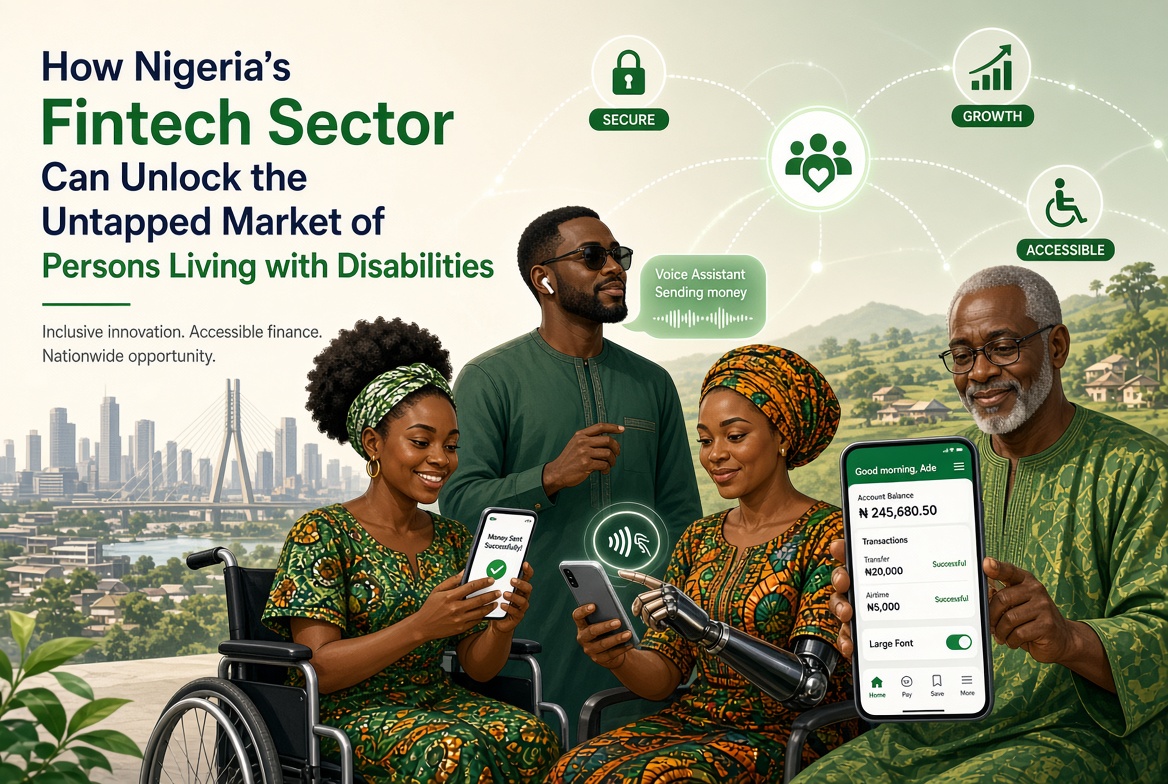
There is also a wider benefit. Features such as voice commands, clearer interfaces, larger text, simpler navigation and multiple authentication options can improve financial services for older people, customers with low digital literacy and people facing temporary physical limitations.
Accessibility can therefore be good product design.
Nigeria’s fintech industry has demonstrated its ability to solve complex problems and reshape financial services. The next challenge is ensuring that the benefits of that innovation reach everyone.
So, the question is no longer simply how many Nigerians can be brought into digital finance. It is whether every Nigerian can participate meaningfully once they get there.
With about 40 million people potentially underserved, inclusion is not merely a social responsibility. It is also a significant business opportunity hiding in plain sight. This is sustainability in practical terms: expanding access while creating new markets, livelihoods and economic value.
Eromosele, a corporate communications expert, sustainability advocate, and Lead Coordinator for the Africa Sustainability Forum 2026, writes via elviseroms@gmail.com.

