


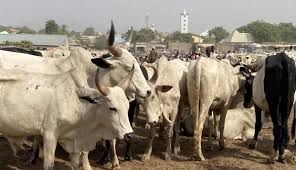
The Federal Government has reaffirmed its commitment to establishing an agro-industrial livestock hub in the Federal Capital Territory as part of efforts to strengthen Nigeria’s livestock value chain and attract investment into the sector.

The assurance was given by Idi Mukhtar Maiha, the Minister of Livestock Development, during a high-level strategic meeting involving the Federal Ministry of Livestock Development, ABIS Group, and the Livestock Productivity and Resilience Support Project (L-PRES) in Abuja.
Maiha said the ministry would collaborate closely with ABIS Group, L-PRES, and other stakeholders to ensure the successful take-off of the proposed ABIS Mega Livestock Processing Facility in Abuja.
According to the minister, the partnership is expected to drive a coordinated approach toward livestock sector development while improving market access for pastoral communities across the country.
He explained that the engagement followed the ministry’s decision to include the ABIS Group in Nigeria’s delegation to a regional training programme on pastoral market access, quality assurance, and inclusive contracting models held in Addis Ababa, Ethiopia.
The training programme, organised by the African Union Inter-African Bureau for Animal Resources (AU-IBAR) under the African Pastoral Market Development platform, brought together participants from Somalia, Botswana, Ethiopia, and Kenya.
Leader of the ABIS Group, Ambassador Emmanuel Usman, commended the ministry for facilitating the organisation’s participation in the programme, describing it as a valuable platform for knowledge sharing and regional collaboration.
Dr. Sanusi Abubakar, National Coordinator of L-PRES, also praised the ministry for supporting the initiative.
Speaking on behalf of the younger generation of the ABIS Group, Kujo Reigans, the company’s General Manager, highlighted lessons from the training, particularly in the areas of pastoral market systems, quality assurance, and inclusive contracting mechanisms within the livestock sector.
Reigans identified key issues discussed during the engagement, including the need for a unified quality assurance framework, the establishment of structured outgrower schemes, access to financing through the Development Bank of Nigeria, and visa-related challenges affecting expatriates working on the project.
He noted that stakeholders stressed the importance of standardised quality assurance systems to improve efficiency, product traceability, and competitiveness across Nigeria’s livestock industry.
According to him, discussions were also held on potential financial support from the Development Bank of Nigeria to expand livestock processing operations and accelerate implementation of the Abuja facility.
The ABIS Group also raised concerns over delays in securing visas for expatriates involved in the project, calling for streamlined processes to support the timely execution of the mega livestock processing hub in the FCT.

