
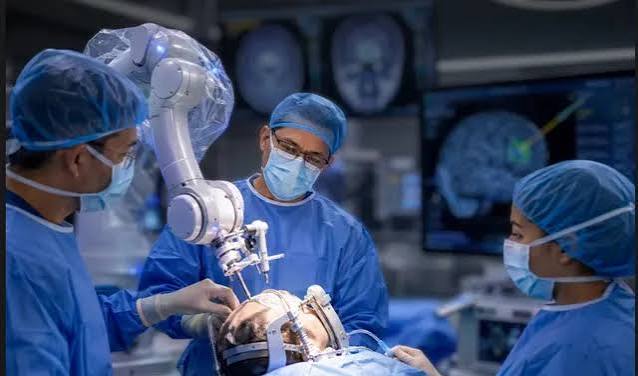
A 48-year-old British man has become the first patient in the world to undergo brain surgery with live artificial intelligence assistance, after surgeons successfully removed his tumour at University College London Hospital.

Rhys Hibbert, a father of two from Bedfordshire, had an 11mm non-cancerous tumour growing on his pituitary gland. Doctors said the tumour could eventually have caused blindness because of its proximity to the optic nerves.
The groundbreaking procedure used an AI system that analysed a live video feed from inside Hibbert’s skull and provided surgeons with real-time guidance on the location of critical blood vessels and nerves.
The technology helped surgeons identify safer areas from which to remove the tumour while avoiding structures that were difficult to see.
“There are no road signs inside our head,” Hibbert said, explaining why he believed the technology could improve patient safety.
Hibbert had been fit and healthy until about 18 months ago, when he collapsed and suffered a seizure while out on his regular lunchtime walk.
A brain scan revealed the tumour on his pituitary gland, a small organ at the base of the skull responsible for producing hormones that regulate important functions including growth, metabolism, blood pressure and body temperature.
As the tumour grew, it began pressing on his optic nerves, reducing his peripheral vision. He also became increasingly tired and dizzy and began tripping over objects.
Despite the risks, Hibbert agreed to become the first patient to undergo surgery using the experimental AI system.
“I wasn’t going to let this tumour stop me,” he said.
The operation was performed through Hibbert’s nose using an endoscope, a thin camera-equipped instrument that allows surgeons to reach the base of the skull without opening the skull itself.
The tumour was located behind layers of bone and tough membrane, making it difficult to determine the safest route for removal. Surgeons also face the challenge that brain anatomy varies from patient to patient.
Researchers say such procedures can carry a 25 to 50 per cent risk of leaving some of the tumour behind and a 0.5 to 2 per cent risk of damaging a major blood vessel.
During the operation, the AI system displayed a second screen alongside the surgeons. It analysed the live surgical footage, tracked instruments and highlighted areas where important blood vessels and nerves were likely to be located.
Researchers trained the system using hundreds of videos of pituitary tumour operations, with specialists identifying and marking important anatomical structures in the footage.
Prof Hani Marcus, one of the surgeons involved, said the AI had effectively been trained on more operations than most surgeons would encounter during their careers.
He described it as an “expert second pair of eyes” that could provide guidance in real time.
However, the researchers stressed that the system does not make surgical decisions. The surgeons remain fully in control and can accept or ignore its recommendations.
The team’s longer-term goal is to develop what Marcus described as a kind of “ChatGPT for surgeons” — an AI assistant that doctors could consult during complex procedures when they need an additional source of expertise.
The technology has been developed and tested over several years with funding from the National Institute for Health and Care Research and Google. Researchers are now preparing a larger clinical trial.