
By Elvis Eromosele

“The Stone Age did not end because the world ran out of stones, and the Oil Age will not end because we run out of oil.” The quote, widely attributed to former Saudi Arabian Oil Minister Ahmed Zaki Yamani, captures a truth Nigeria has grappled with for decades.
Successive governments have long recognised the need to diversify the economy away from oil dependence. Increasingly, experts have pointed to the digital economy as Nigeria’s most promising path to sustainable growth. The sector has already demonstrated enormous potential, and current developments suggest that its biggest gains may still lie ahead.
Indeed, if projections by communications experts are anything to go by, Nigeria could be on the verge of a major economic transformation through the ongoing review of the 26-year-old National Telecommunications Policy (NTP) 2000. Officials believe the revised framework could unlock up to two per cent additional GDP growth, create more than two million jobs, and generate nearly ₦2 trillion in additional tax revenues by 2030. The implications are profound.
Now, it is worth recalling that the NTP 2000 laid the foundation for the telecommunications revolution that transformed Nigeria’s communications landscape. The policy empowered the Nigerian Communications Commission (NCC) to liberalise the sector and attract private investment at a time when access to telephone services was extremely limited.
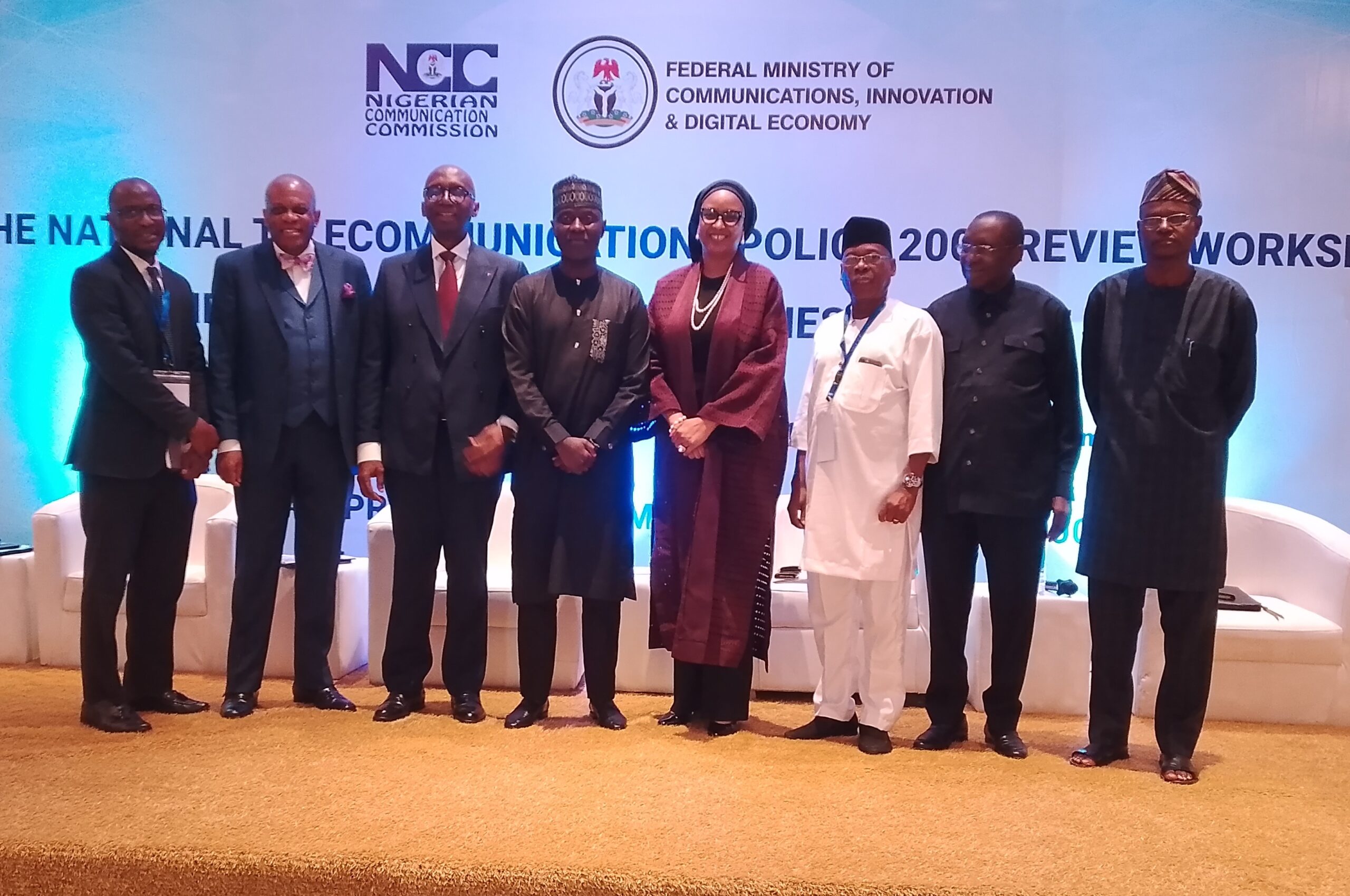
Speaking at the recent high-level NTP 2000 Review Workshop in Lagos, Aminu Maida, Executive Vice Chairman and CEO of the NCC, reflected on the remarkable transformation that followed. “When the NTP 2000 was introduced, Nigeria had fewer than 500,000 telephone lines serving over 120 million people under the monopoly of the Nigerian Telecommunications Limited (NITEL),” he said. “The policy liberalised the market, attracted massive private investment, and, supported by the Nigerian Communications Act 2003, turned scarcity into abundance.”
Dr Maida noted that within a decade, Nigeria moved from endless waiting lists for telephone lines to tens of millions of connected citizens. Reports indicate that today there are over 180 million connected lines.
Today, telecommunications has evolved far beyond voice communication. It now powers banking, fintech, e-commerce, education, healthcare, governance, agriculture, manufacturing, transportation, and public services.
Dr Maida aptly described telecommunications as the “productivity infrastructure” of the Nigerian economy.
This explains why the review of the NTP 2000 is being positioned not as a routine sector update, but as a national development imperative. The goal is to reposition telecommunications as the foundational infrastructure supporting every aspect of economic activity.
The Presidency echoed this broader vision. Hadiza Bala Usman, Special Adviser to President Bola Ahmed Tinubu on Policy and Coordination, while acknowledging the success of the 2000 policy in liberalising the market and driving competition, stressed that today’s realities demand a more forward-looking framework. She argued that any modern telecommunications policy must address broadband expansion, affordability, digital inclusion, infrastructure resilience, cybersecurity, digital skills, data governance, and emerging technologies.
The review of the NTP 2000 is a massive opportunity for a fresh start.
The reality is that despite the impressive progress recorded over the past quarter of a century, several challenges continue to hinder the sector’s growth. Stakeholders constantly highlight issues such as fibre cuts, vandalism, theft, multiple taxation, high energy costs, right-of-way bottlenecks, delayed approvals, and weak coordination between federal and subnational governments. These problems continue to slow broadband expansion and weaken service quality, especially in rural and underserved communities.
This is precisely why many experts believe Nigeria must now embrace a new regulatory philosophy, one that moves beyond basic market supervision to full ecosystem stewardship. The emerging digital economy requires policies capable of addressing artificial intelligence (AI), satellite broadband, the Internet of Things (IoT), cloud infrastructure, digital sovereignty, and data governance.
The revised policy is expected to preserve the core principles of competition, universal access, and consumer protection while also promoting innovation, investment, resilience, and inclusive growth. Stakeholders are already developing practical recommendations around regulatory coordination, infrastructure protection, digital skills development, and strategies for accelerating digital transformation.
The ambitions are ambitious but necessary: expand the tax base, improve public service delivery, bridge the digital divide, create jobs, and establish Nigeria as a leading digital economy in Africa by 2030.
Undoubtedly, as Nigeria’s population and economy continue to grow, reliable, affordable, and high-quality digital connectivity is becoming increasingly essential for empowering citizens, businesses, and communities.
Ultimately, the success of the policy review will not be judged by the quality of speeches delivered at conferences and workshops, but by the strength of implementation, the consistency of political will, and the measurable outcomes achieved.
With Africa’s largest population and one of the continent’s most vibrant telecom markets, Nigeria stands at a defining moment. The ongoing review of the NTP 2000 presents a strategic opportunity to transform digital infrastructure into a powerful engine for sustainable and inclusive national development.
The conversations at the Lagos workshop could shape how Nigerians live, work, learn, communicate, and do business for decades to come. If implementation matches ambition, the projected digital economy windfall could become one of the most significant economic dividends of the Renewed Hope era.

Elvis Eromosele, a corporate communications professional and sustainability advocate, wrote via elviseroms@gmail.com.