


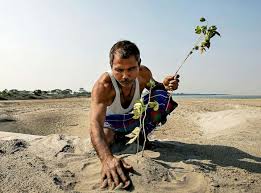
In a world often overwhelmed by the scale of environmental degradation, stories of quiet, consistent action remind us that transformation is possible, even in the most unlikely places. One such story is that of Jadav Payeng, the Indian environmentalist who turned a barren sandbar along the Brahmaputra River into a thriving forest over several decades.

While his story has inspired global admiration, its deeper relevance may lie thousands of miles away, in Northern Nigeria, where desertification continues to threaten livelihoods, food security, and national stability.
Across states like Borno State, Yobe State, Katsina State, and Sokoto State, the land is steadily losing its vitality. The once-productive soil is giving way to advancing sand dunes. Trees are disappearing. Water sources are shrinking.
According to estimates from the Federal Ministry of Environment, Nigeria loses thousands of hectares of land annually to desert encroachment. This is not just an environmental issue; it is an economic and security concern.
As arable land diminishes, farmers and herders are pushed into competition over scarce resources, a dynamic that has contributed to persistent conflicts across the region. Food production declines, rural poverty deepens, and migration pressures increase.
Nigeria is not lacking in policies or initiatives. Programs aligned with the African Union’s Great Green Wall project have sought to plant millions of trees across the Sahel. Yet, progress has often been slow, fragmented, and heavily dependent on government funding cycles.
This is where the lesson from Payeng becomes profound.
He did not wait for a national policy to be established. He did not depend on large budgets or international donors. He started with what he had, seedlings, time, and commitment, and built an ecosystem one tree at a time.
Imagine if such a model were localised across Northern Nigeria.
What if every community in the frontline states adopted a “micro-forest” approach?
- Local farmers are dedicating small portions of land to tree planting
- Youth groups taking ownership of community green belts
- Traditional institutions enforcing tree protection norms
- Schools integrating environmental stewardship into daily routines
Over time, these small, consistent efforts could yield significant results, stabilising soil, restoring moisture, and gradually reversing land degradation.
The science supports this. Trees act as windbreakers, reduce soil erosion, improve rainfall infiltration, and enrich the soil through organic matter. In essence, they rebuild ecosystems from the ground up.
Government still has a crucial role to play, but perhaps as an enabler rather than the sole driver.
Agencies can:
- Provide seedlings and technical support
- Incentivise tree planting through subsidies or carbon credits
- Protect restored lands through legislation
- Partner with local communities for monitoring and sustainability
But the real engine of change must be the people.
Payeng’s story underscores a simple truth: environmental restoration is most powerful when it becomes personal.
Nigeria has its own history of environmental resilience. From community-led erosion control in the South-East to local irrigation innovations in the North, the spirit of adaptation is not new.
What is needed now is scale, consistency, and ownership.
Desertification did not happen overnight. It is the result of years of deforestation, overgrazing, and climate pressures. Reversing it will also take time, not months or political cycles, but decades.
That is perhaps the hardest lesson of all.
The story of Majuli Island is not just about one man planting trees. It is about what becomes possible when persistence meets purpose.
Northern Nigeria may not need one Jadav Payeng.
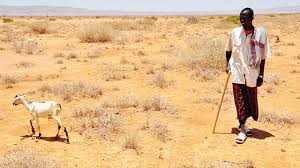
It may need thousands.
Farmers, students, community leaders, and everyday citizens, each planting, protecting, and nurturing life back into the land.
Because in the end, the fight against desertification will not be won in conference rooms or policy documents alone. It will be won in fields, in villages, and in the quiet, daily decisions of people who refuse to accept that barren land must remain barren.
And perhaps, years from now, there will be forests where there is currently only sand, living proof that Nigeria, too, chose to act.

