


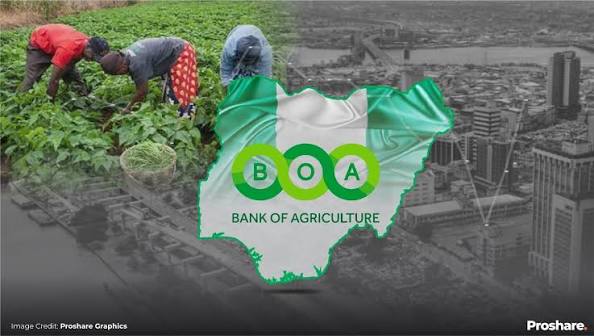
The Bank of Agriculture (BOA) is stepping up efforts to improve women farmers’ access to finance, agricultural inputs, mechanisation and markets as part of a broader strategy to increase food production and strengthen Nigeria’s agricultural value chains.

The bank said its interventions are designed to address the challenges limiting the productivity of women and other smallholder farmers, while ensuring agricultural financing supports the entire production cycle rather than stopping at the disbursement of loans.
As part of the initiative, BOA recently engaged women farmers in Bwari Area Council of the Federal Capital Territory, providing agricultural inputs to support their farming activities.
The bank said the intervention reflects its strategy of responding to the practical challenges farmers face and ensuring they have the resources needed to turn access to land, labour and financing into higher production and income.
Women play a major role in Nigeria’s agricultural sector but continue to face significant barriers to finance and productive resources.
Estimates cited by the Food and Agriculture Organisation indicate that women account for up to 70 per cent of the agricultural workforce. The World Bank has also noted that reducing gender gaps in access to productive resources could increase agricultural output, improve food security and reduce poverty.
Despite their contribution, women farmers remain poorly served by formal financial institutions.
Recent World Bank data cited by BOA indicate that only 3 per cent of female farmers in Nigeria are formally enrolled in financial systems, compared with 10 per cent of male farmers.
Ayodeji Oludare Sotinrin, BOA Managing Director and Chief Executive Officer, said the bank’s approach is focused on addressing the multiple constraints facing farmers. “Women are already contributing significantly to agriculture and to Nigeria’s food system. Our responsibility is to ensure that the systems around them give them a better opportunity to produce, grow and participate in the value chain.”
Sotinrin said agricultural financing must go beyond providing funds. “Agricultural financing cannot end with disbursement. Farmers need access to inputs, mechanisation, markets and other support required to turn financing into output. That is the ecosystem we are building at the Bank of Agriculture.”
According to the bank, the strategy is being implemented through its Renewed Hope Smallholder Support and Value Chain Fund, which is working with farmer aggregation companies to bring more than two million smallholder farmers into a structured, Federal Government-backed on-lending framework.
Under the model, farmers are expected to receive financing alongside agricultural inputs, agronomic support and offtake arrangements.
The objective is to increase actual farm output and farmer incomes rather than measure success solely by the volume of loans disbursed.
BOA is also deploying a N250 billion facility to provide single-digit financing to smallholder farmers.
The bank’s ongoing N1.5 trillion recapitalisation is expected to further strengthen its capacity to expand agricultural lending and reach more farmers across the country.
BOA said women farmers face a combination of financial exclusion and limited access to inputs, technology, mechanisation and markets.
Its emerging financing model is therefore designed to connect farmers not only with capital but also with production support, infrastructure and reliable market opportunities.
Through its Guaranteed Minimum Price Aggregation Programme, the bank is linking farmers producing selected commodities to structured aggregation systems, accredited warehouses and guaranteed offtake arrangements.
The initiative is expected to provide farmers with greater certainty about where and how their produce will be sold, while reducing some of the risks associated with production and post-harvest marketing.
BOA said closing the gap between farmers’ productive potential and their access to finance and other resources will be critical to Nigeria’s efforts to increase domestic food production and strengthen food security.
The bank said it would continue to deepen partnerships, financing mechanisms and value-chain interventions aimed at bringing more farmers, particularly women and underserved smallholder producers, into the formal agricultural economy.
The broader goal is to create stronger links between finance, production, processing and markets, enabling farmers to increase output, earn more and contribute more effectively to Nigeria’s food system.

