
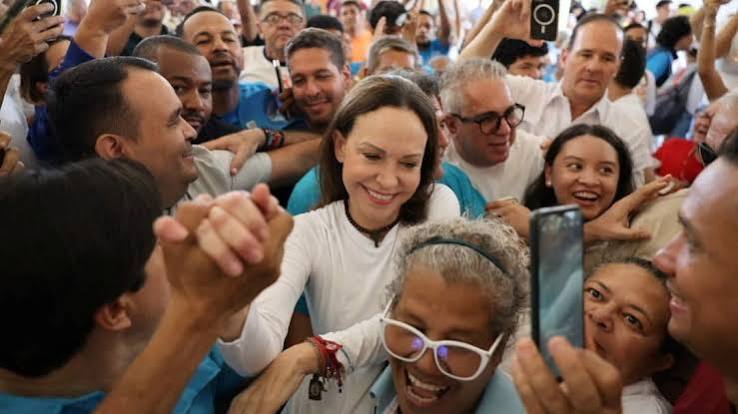
Maria Corina Machado, Venezuelan opposition leader and Nobel Peace Prize laureate, has returned to the country after more than 10 months abroad, raising the political stakes as pressure mounts on the government to announce fresh elections.

Machado confirmed her arrival on Sunday, October 25, in a social media post declaring, “I am here. With you.”
Edmundo Gonzalez, the opposition figure widely recognised by the opposition as the winner of Venezuela’s disputed 2024 presidential election, also confirmed her return, describing her as the country’s opposition leader.
Footage shared by the political organisation Comando Con Venezuela showed Machado arriving at a church in the state of Lara, where supporters welcomed her.
Her homecoming comes days after thousands of Venezuelans participated in a nationwide opposition protest demanding a free and transparent presidential election. It was the first national opposition demonstration in nearly two years, reflecting growing public frustration over the absence of an election timetable.
Machado’s return could provide fresh momentum to an opposition movement seeking to restore electoral competition following the dramatic removal of former President Nicolas Maduro by US forces in January 2026.
Venezuela has remained under an interim administration led by Vice President Delcy Rodriguez since Maduro was captured and removed from Caracas by the United States military in January.
Rodriguez has received the backing of US President Donald Trump and has worked with his administration on political and economic reforms, including arrangements involving Venezuela’s vast oil resources.
However, her tenure has extended beyond the initial 90-day period she was authorised to serve, without a date being announced for a new presidential election.
Rodriguez pledged at the United Nations General Assembly in September that elections would take place but did not specify when. The United States has maintained that Venezuela is not yet ready for an election.
The delay has become a major point of contention for the opposition, which argues that a clear electoral timetable is necessary to establish a legitimate political order.
Venezuela’s 2024 presidential election remains deeply disputed. Although the authorities declared Maduro the winner, the opposition maintained that its candidate, Gonzalez, had prevailed. The controversy triggered international criticism and intensified calls for a credible electoral process.
Machado’s return follows a period of political uncertainty and international advocacy.
She largely disappeared from public view after being briefly detained in January 2025. She later re-emerged in Norway in December of that year, where she received the Nobel Peace Prize in recognition of her efforts to challenge Maduro’s government and advance democratic change in Venezuela.
Before returning, Machado had made several unsuccessful attempts to enter the country. Her team said in September that she had tried seven times within a few weeks.
Her return now comes against the backdrop of renewed opposition mobilisation and negotiations involving the United States and Venezuela’s interim authorities.
US Secretary of State Marco Rubio attributed the conditions that enabled Machado’s return to US-supported reconciliation talks. He said the process had already resulted in the release of hundreds of political prisoners and the return of hundreds of opposition figures from exile.
The extent to which these developments will translate into broader political freedoms and a credible electoral process remains uncertain.