


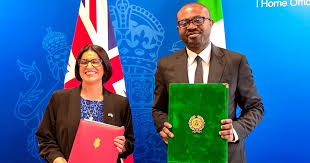
The United Kingdom and Nigeria have formalised a new agreement to streamline the deportation of failed asylum seekers and convicted offenders, marking a major step in tightening immigration enforcement and reducing bureaucratic bottlenecks.

The deal was signed on Thursday during President Bola Tinubu’s state visit to the UK by UK Home Secretary Shabana Mahmood and Nigeria’s Minister of Interior, Dr Olubunmi Tunji-Ojo. It builds on ongoing UK-Nigeria collaboration on migration, border security, and justice issues.
Under the agreement, Nigerian authorities will accept diplomatic notes, known as “UK Letters,” in place of traditional travel documents like passports. For years, the absence of valid travel papers has slowed deportations, creating legal and logistical hurdles for UK authorities.
Commenting on the agreement, UK Home Office Minister Alex Norris said:
“Today’s agreement is another step in our mission to restore order to the border by ensuring those who have no right to be here are swiftly removed. Nigeria is a key partner in our work to tackle illegal migration.”
Tunji-Ojo added that the deal reflects Nigeria’s commitment to a transparent and rules-based migration system that is safe, orderly, and mutually beneficial. He noted that it would also help facilitate trade, ease business mobility, and support Nigeria’s vision of a trillion-dollar economy under President Tinubu, while addressing irregular migration challenges.
UK authorities estimate that about 961 Nigerian nationals have exhausted their asylum appeals, while another 1,110 foreign national offenders await deportation. The agreement also covers Nigerians who have overstayed their visas, significantly expanding the enforcement scope beyond asylum cases.
Beyond deportations, the arrangement includes measures to combat cybercrime and visa fraud, with both countries pledging to dismantle criminal networks exploiting migration pathways. A new document verification system will strengthen visa application integrity, while Nigeria will review its legal framework to impose tougher penalties for immigration-related offences.
The deportation agreement is part of a broader diplomatic and economic engagement during Tinubu’s UK visit, the first in 37 years. Highlights include:
- NSIA Deal with Asset Green Ltd. – A $500 million dairy project aimed at reducing Nigeria’s dependence on imported dairy and boosting domestic production.
- £746 Million Port Modernisation Agreement – Funding for upgrades at Apapa and Tin Can Island ports in Lagos, enhancing trade infrastructure and efficiency.
These initiatives reflect a growing focus on trade, investment, and border management as pillars of bilateral cooperation.
Analysts note that the new deportation framework will accelerate enforcement of UK immigration laws while ensuring that Nigerian nationals’ rights are respected. The deal also strengthens collaboration between immigration and law enforcement agencies, setting a model for tackling irregular migration across Africa and Europe.
By simplifying deportation processes and addressing visa fraud, both countries aim to create a safer, more transparent migration system, supporting broader economic and diplomatic ties.

