


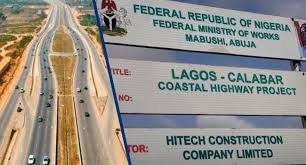
The Federal Government has secured about $1.2 billion in financing from the United Arab Emirates to fast-track construction of a major section of the Lagos–Calabar Coastal Highway.

The Presidency disclosed this in a statement on Friday, according to Bloomberg, noting that the funds will be used to deliver a 56-kilometre stretch of the coastal freeway, one of Nigeria’s flagship infrastructure projects.
When completed, the Lagos–Calabar Coastal Highway is expected to span about 700 kilometres along Nigeria’s Atlantic coastline, linking key economic and commercial hubs across the southern corridor.
What the government says
President Bola Tinubu described the financing as a major milestone that will ensure uninterrupted progress on the project.
“This is a significant achievement. Closing this transaction means the Lagos–Calabar Coastal Highway will continue unimpeded,” Tinubu said, adding that the government will keep exploring innovative financing options to bridge Nigeria’s infrastructure gap.
Context and funding structure
The latest facility follows $747 million secured in July for another section of the highway, underscoring the project’s phased funding approach.
The deal was led by Deutsche Bank as Global Coordinator and Lead Arranger, alongside a consortium that includes First Abu Dhabi Bank, Afreximbank, the ECOWAS Bank for Investment and Development (EBID), Nexent Bank N.V., and Zenith Bank. The loan was fully underwritten by First Abu Dhabi Bank, with risk mitigation provided by the Islamic Corporation for the Insurance of Investment and Export Credit, highlighting growing Gulf participation in Nigeria’s infrastructure financing.
Dany Abboud, Hitech Construction’s Managing Director, confirmed that over 70 per cent of the funded section has been completed, noting that the use of Continuously Reinforced Concrete Pavement (CRCP) technology will enhance durability and long-term cost efficiency.
Why it matters
The UAE-backed loan strengthens funding certainty for one of Nigeria’s largest road projects, and signals sustained international confidence in the country’s infrastructure programme.
If completed as planned, the coastal highway is expected to cut travel time, boost logistics, trade and tourism, and deepen connectivity among southern states, key pillars of the Tinubu administration’s growth agenda.

