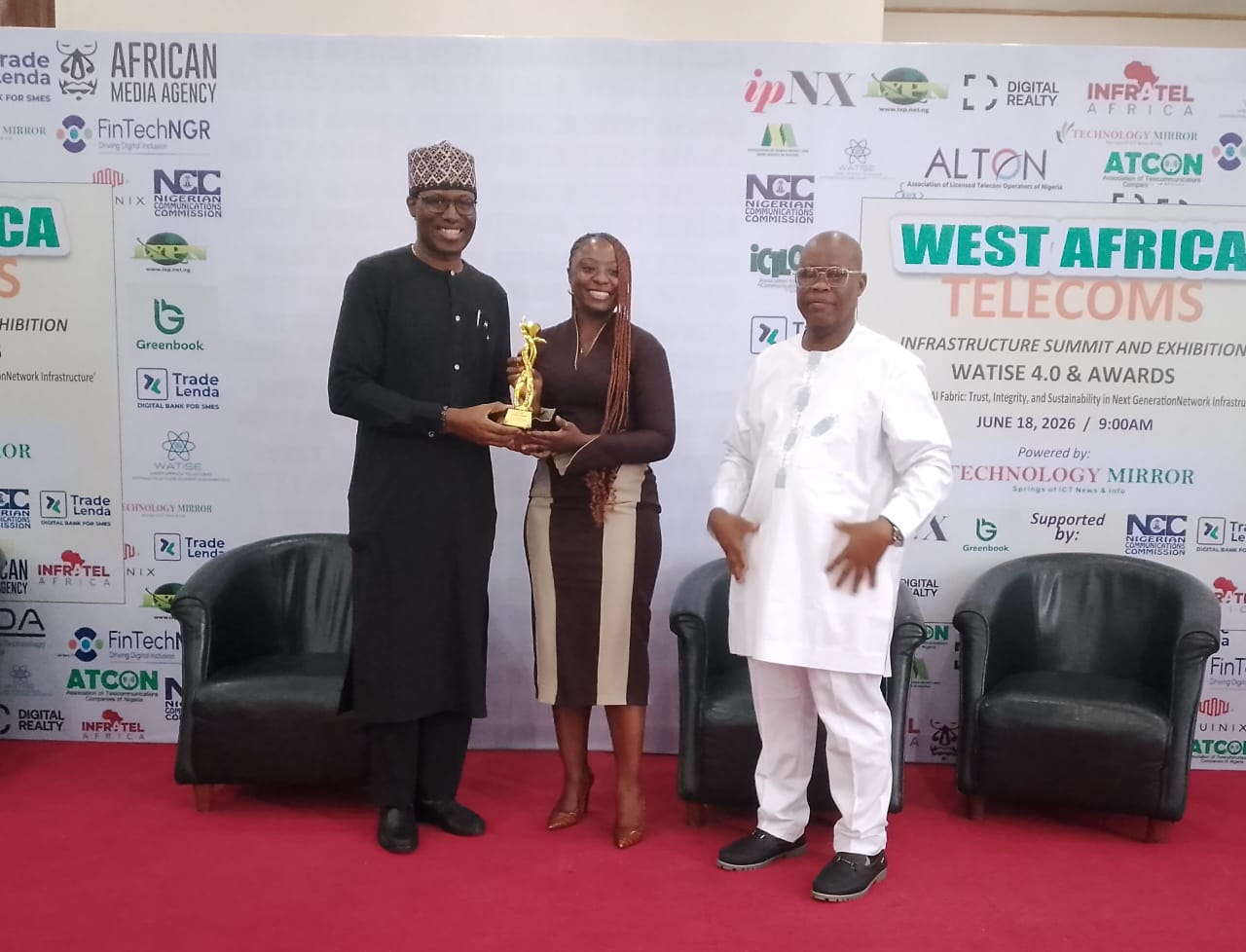
…conferred with WATISE Award for Best Banking-As-A-Service Innovation

Trade Lenda is redefining digital banking for small and medium-sized enterprises (SMEs) through artificial intelligence-driven solutions designed to bridge longstanding financing gaps and unlock growth opportunities for entrepreneurs across emerging markets.
The fintech company made this known at the West Africa Telecoms Infrastructure Summit and Exhibition (WATISE 4.0), where it outlined how artificial intelligence and machine learning are transforming access to finance and reshaping the future of SME banking in Africa.
Speaking during the event, Juliana Adum-Botchey, Chief Operating Officer of Trade Lenda, represented by Elizabeth Kasali, said access to finance remains one of the most significant obstacles confronting millions of small businesses across the continent.
According to her, many SMEs are routinely classified as “unbankable” by traditional financial institutions, not because they lack the capacity or potential to succeed, but because conventional banking systems often lack adequate visibility into their operations.
She explained that traditional lenders typically rely on formal financial statements, collateral and lengthy credit histories when making lending decisions. However, many small businesses operate outside these conventional structures, making it difficult for banks to accurately assess their creditworthiness.
“Many small businesses are considered too risky for traditional lenders because they do not possess extensive credit histories or formal documentation. The challenge is not necessarily one of risk; it is largely a data problem,” she said.
To address this challenge, Trade Lenda has developed an AI-powered lending platform that uses alternative data sources to evaluate businesses, moving beyond the limitations of conventional credit assessment methods.
The company said its proprietary artificial intelligence and machine-learning models analyse transaction patterns, business activities, digital footprints and other real-time data points to assess the financial health of enterprises and determine creditworthiness within minutes.
This approach, according to the company, is fundamentally changing the lending process by replacing manual assessments and paperwork-heavy procedures with intelligent, data-driven decision-making.
“We are completely redefining what digital SME banking looks like,” the company stated. “Rather than waiting weeks for loan officers to review applications and make decisions, our technology enables us to assess businesses and make lending decisions within minutes.”
The impact of this innovation is already being felt by entrepreneurs who often require immediate access to working capital to seize business opportunities.
Trade Lenda revealed that while conventional loan applications can take weeks to process, its platform is capable of approving and disbursing loans in less than six hours.
According to the company, this speed can make a critical difference for small business owners who need quick financing to purchase inventory, meet customer demand or respond to changing market conditions.
Beyond lending, Trade Lenda said it is building a comprehensive digital financial ecosystem designed to support the long-term growth and sustainability of SMEs.
The company believes that access to credit alone is insufficient to drive lasting business success. As a result, it has integrated a range of embedded financial services into its platform to provide entrepreneurs with broader support.
These services include micro-investment opportunities, embedded insurance solutions, credit life assurance and goods-in-transit insurance products, all designed to help businesses manage risks while pursuing growth.
“What truly differentiates our approach is that we are not simply creating a digital lending platform. We are building an intelligent ecosystem that empowers entrepreneurs with the tools they need to grow, manage risks and build sustainable businesses,” the company explained.
Trade Lenda also challenged the long-held perception that micro and small businesses represent inherently high-risk lending segments.
According to the company, the use of advanced analytics and alternative data has shown that many informal traders and small-scale entrepreneurs are highly creditworthy when assessed through the right lens.
The company reported strong repayment performance across its customer base, demonstrating that technology-enabled lending can expand access to finance while maintaining healthy portfolio quality.
“We are proving that when small businesses are equipped with the right digital tools and financial support systems, they perform exceptionally well. Their repayment behaviour continues to challenge outdated assumptions about the risks associated with lending to micro-enterprises,” it said.
Trade Lenda further argued that the true promise of artificial intelligence extends beyond improving operational efficiency for large organisations. Rather, it lies in its ability to democratise access to economic opportunities and create a more inclusive financial system.
The company noted that AI is transforming smartphones into gateways to institutional capital, enabling entrepreneurs to access financial services regardless of location or proximity to traditional banking infrastructure.
By replacing traditional collateral requirements with digitally generated trust mechanisms, AI can unlock new opportunities for entrepreneurship, job creation and economic development.
“The true power of artificial intelligence lies in its ability to level the playing field,” Trade Lenda stated. “We are turning the smartphone in the hands of market traders and small business owners into a gateway to capital, opportunity and growth.”
Looking ahead, the company expressed confidence that the future of banking in emerging markets will belong to institutions that use technology to expand access rather than create additional barriers.
Trade Lenda reiterated its commitment to leading that transformation, using artificial intelligence as a catalyst for financial inclusion, economic empowerment and sustainable growth.
“As digital banking evolves across emerging markets, the future will belong to organisations that use technology to build bridges instead of barriers,” the company said. “Through AI, we are helping to create a more inclusive financial ecosystem and empowering small businesses to achieve their full potential, one entrepreneur at a time.”
The firm was conferred with the WATISE Award for Best Banking-As-A-Service Innovation.