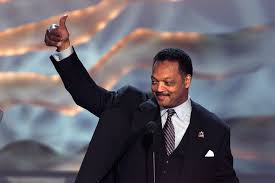
The Rev. Jesse Jackson, who has died aged 84, was never content to be a footnote in another man’s movement. A protégé of Martin Luther King Jr., he inherited not only the cadences of the Black pulpit but also its restless impatience. Where others saw the civil rights struggle as a chapter in American history, Mr Jackson saw an unfinished sentence. He spent his life trying to complete it.
Born in Greenville, South Carolina, in the thick of Jim Crow segregation, Mr Jackson learned early the grammar of humiliation and the rhetoric of resistance. He joined Dr King’s Southern Christian Leadership Conference in the 1960s and was present in Memphis in 1968 when an assassin’s bullet felled the movement’s most luminous figure. From that moment, Mr Jackson styled himself not as heir but as standard-bearer – less the custodian of a legacy than the architect of its expansion.
In 1971 he founded Operation PUSH (People United to Save Humanity), later folded into the Rainbow/PUSH Coalition. The name was vintage Jackson: muscular, moral and unembarrassed by its ambition. He understood that civil rights, to endure, must become civil economics. Corporate boardrooms and city halls were as much his terrain as church basements. He cajoled companies into hiring more black executives, pressed banks to lend in neglected neighbourhoods and insisted that political representation without economic inclusion was a hollow victory.
Twice, in 1984 and 1988, he sought the Democratic nomination for president. Both campaigns were long shots; both altered the political weather. His “Rainbow Coalition” stitched together African-Americans, Latinos, poor whites, family farmers and disaffected liberals into a tapestry that anticipated the multiracial alliances of later decades. He did not win. But he expanded the electorate, registered millions of new voters and forced his party to reckon with constituencies it had too often taken for granted.
Critics accused him of theatricality, of blurring the line between prophecy and self-promotion. He relished a microphone and could turn a phrase into a drumbeat. Yet even detractors conceded his utility. Mr Jackson was frequently dispatched to the world’s trouble spots, negotiating the release of hostages, advocating for political prisoners, and inserting himself into conflicts from the Middle East to sub-Saharan Africa. He operated in the grey space between diplomacy and activism, where moral authority can sometimes travel further than official credentials.
He was, above all, a pathfinder. The America of his youth, where a Black man’s ambition was bounded by law, gave way, during his lifetime, to one that elected a Black president. Though he did not create that transformation alone, he helped normalise the idea that the highest offices were not racially reserved. His presidential bids, once deemed quixotic, cleared a psychological runway for those who followed.
Time softened neither his voice nor his convictions. Even as illness narrowed his public appearances in later years, he remained an elder statesman of protest politics, summoned when injustice flared and quoted when conscience was required. He belonged to a generation that believed change was wrestled from the powerful, not requested of them.
The paradox of Jesse Jackson’s career is that he was both an insider and an insurgent. He dined with presidents and marched with sanitation workers; he brokered corporate deals and thundered against corporate greed. If the civil rights movement began as a demand for entry, Mr Jackson’s life’s work was to argue for equity once inside.
He leaves behind not a single monument but a method: organise the marginalised, expand the coalition, insist on dignity as a non-negotiable. In the long American argument over race and justice, he was seldom the quietest voice. But he was, for more than half a century, among the most persistent.