



The Nigerian Foreign Ministry has publicly announced that around 130 nationals are registered for voluntary repatriation. NICASA’s own working list, Onyekwelu told me, has now reached approximately 300 names and is still being collected. His team is coordinating with the Nigerian High Commission and South Africa’s Department of Home Affairs, documenting those without papers, and asking the Federal Government to repatriate them under a proviso that they will not return.
The work began before the nationwide protests. NICASA’s advice to its members in the run-up was straightforward: lock up your businesses for at least three days. Onyekwelu was clear about why. Past episodes have not stayed peaceful, and it is businesses and personal safety that absorb the cost. He described a school in Pretoria where parents were called mid-morning to collect their children because a crowd had gathered at the gates in full view of the police. The psychological residue of that morning, for the child, the parent, and the teacher, may never be reported.
The harder facts behind the diplomacy are these. Amamiro Chidiebere Emmanuel died on 25 April 2026 from injuries sustained on 20 April after a beating by members of the South African National Defence Force in Port Elizabeth. On the same day, Nnaemeka Matthew Andrew’s body was discovered at the Pretoria Central Mortuary following an alleged interaction with members of the Tshwane Metro Police. Nigerian Foreign Minister Bianca Odumegwu-Ojukwu has called both incidents condemnable. Bobby Moroe, Pretoria’s Acting High Commissioner has been summoned in Abuja. Ghana has lodged its own complaint; Mozambique is expected to follow.
This is the point at which it pays to be precise about what is happening and what is not.
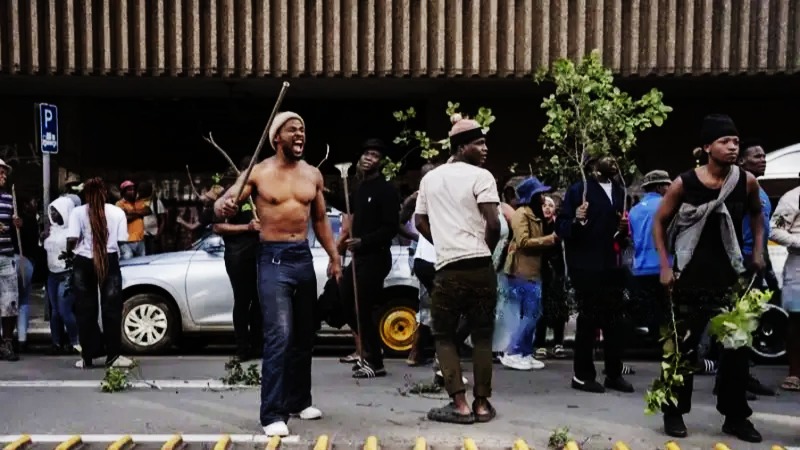
What is happening are organised vigilante movements, principally March and March, fronted by Jacinta Ngobese-Zuma, and Operation Dudula, fronted by Zandile Dabula, have moved from rhetoric to action. They have demanded immigration documents from foreign nationals on the street, attempted to block school access for migrant children in KwaZulu-Natal, and targeted foreign-owned shops in Pietermaritzburg.
However, there seems to be no public reckoning with why the targets are foreign. South Africa’s unemployment rate sits above 33 per cent. Statistics South Africa’s most recent estimate puts immigrants at roughly 3.9 per cent of the population. The arithmetic does not support the claim that migrants caused the country’s labour-market crisis. The political utility of the claim is what keeps it in circulation.
Onyekwelu puts it bluntly: “Whenever there is a political end or some other end to be achieved, the immigrant becomes the scapegoat.” He is correct, and the pattern is older than the current protests. When domestic governance fails to deliver work, water, electricity and basic services, the temptation to relocate the failure onto the most visible outsider is older than the post-colonial state.
This is also where the continental risk sits. South African capital, from MTN to Standard Bank to Shoprite to MultiChoice, depends on the rest of the continent for its footprint and earnings. The longer the images circulating out of Johannesburg, Pretoria, Durban, Cape Town and Pietermaritzburg are read across African capitals, the harder that footprint is to defend. The constituency for restraint inside South Africa is wider than the protest organisers want to admit.
For NICASA, the work this week is administrative. Three hundred names, engagement with both Nigerian and South African governments, and repatriation under a proviso. Onyekwelu also told me, on the record, that since the hostilities began a number of Nigerians he knows personally, alongside other African nationals, have already left South Africa for other countries. Where they go next, and what they take with them in the way of capital, skills and trust, is the next part of this story.
-Akin Alaka. Reporting from Lagos, in conversation with the Nigerian Citizens Association of South Africa.

