


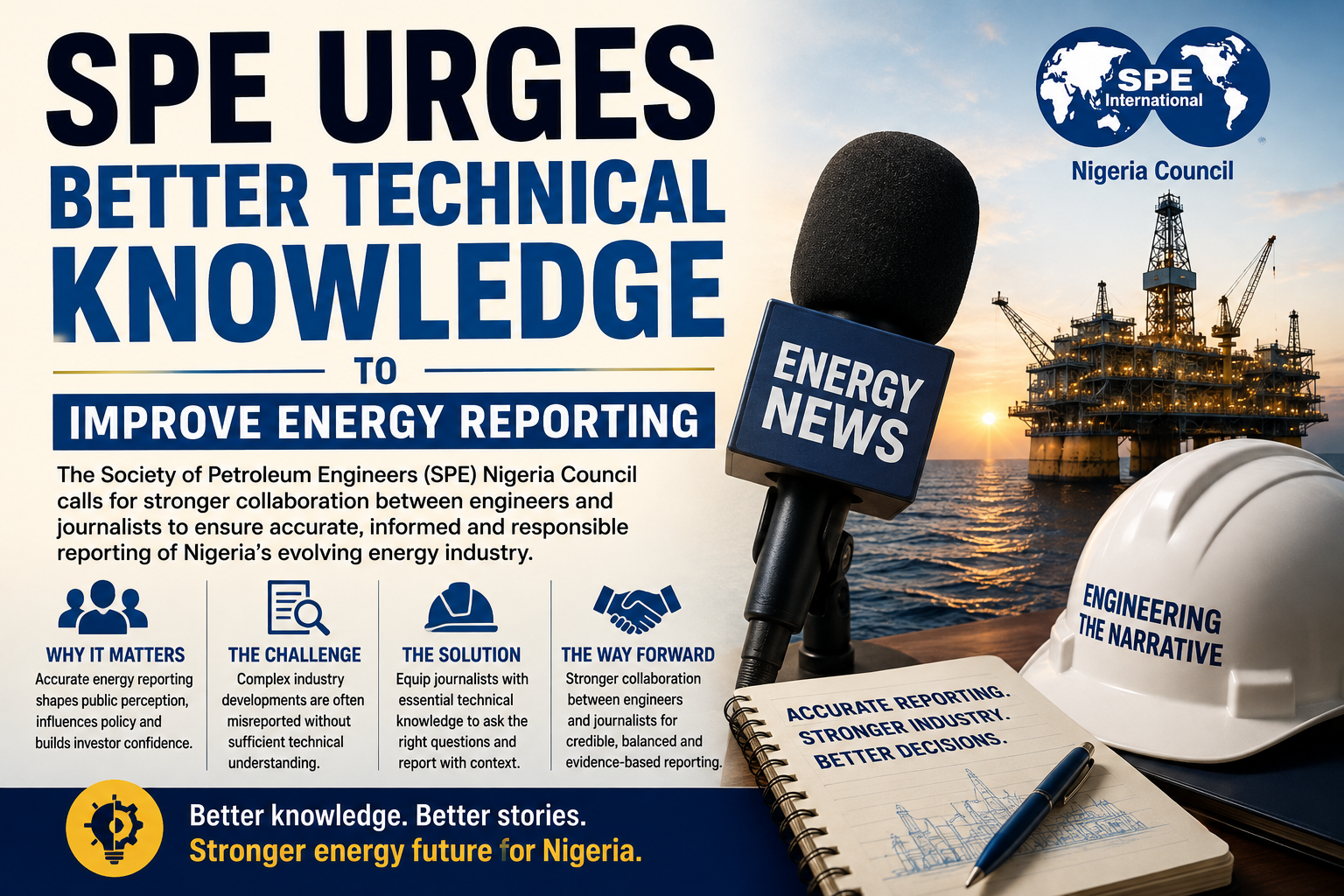
The Society of Petroleum Engineers (SPE) Nigeria Council has called for greater technical knowledge among journalists covering the energy sector, warning that inaccurate or superficial reporting could undermine investor confidence, distort public understanding and weaken policy discussions.

The council also urged stronger collaboration between engineers and the media to improve the quality, accuracy and credibility of energy reporting in Nigeria.
The call was made during the Executive Masterclass on Energy Journalism held in Lagos. The programme, organised by the SPE Nigeria Council in partnership with Sequest Upstream Company Limited, was themed “Engineering the Narrative: Why Technical Knowledge Matters in Energy Journalism.”
Speaking at the event, Engr. Francis Nwaochei, Chairman of the SPE Nigeria Council, said Nigeria’s energy industry has become increasingly complex, making it essential for journalists to move beyond headline reporting and develop a deeper understanding of technical issues.
He noted that media reports increasingly influence public opinion, government policy and investment decisions, making accuracy and context more important than ever. “The stories that appear in our newspapers, on television, online platforms and across social media influence public perception, investor confidence and even policy conversations. That is why accuracy matters,” he said.
According to Nwaochei, Nigeria’s energy conversation now extends far beyond crude oil production to include gas monetisation, energy security, carbon management, artificial intelligence, digital technologies, infrastructure development, local content, financing and low-carbon energy solutions.
He said this growing complexity requires journalists to strengthen their technical capacity to accurately interpret developments across the sector.
Nwaochei stressed that the masterclass was not intended to turn journalists into petroleum engineers but to equip them with enough technical understanding to ask informed questions, verify claims and produce balanced, evidence-based reports. “Our objective is to equip journalists with sufficient technical understanding to ask the right questions, conduct due diligence and produce balanced, evidence-based reports,” he said.
He noted that industry announcements are often reported without sufficient scrutiny, leading to confusion over project timelines, production figures and investment commitments.
For instance, he explained, installed production capacity is different from actual production, reserve estimates are not the same as recoverable output, and a licence award should not be mistaken for the commencement of production.
Likewise, announcing an investment does not necessarily mean funds have been deployed, while acquisitions only create value after successful execution.
According to him, understanding these distinctions enables journalists to explain industry developments rather than simply reproduce corporate statements.
Nwaochei said technically accurate reporting has become increasingly important as Nigeria competes for global investment in a more selective capital market.
He encouraged journalists to ask critical questions before publishing energy stories, including what reported figures actually represent, whether claims have been independently verified, the stage of project development and any outstanding regulatory approvals. “Those simple questions can make the difference between a good story and a truly insightful one,” he said.
Industry observers, he added, rely on credible information to assess regulatory certainty, project risks and commercial viability, making responsible journalism an important part of Nigeria’s investment ecosystem.

