
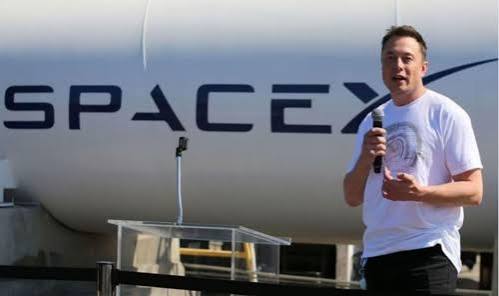
…Elon Musk says investors underestimate the company as Starlink powers growth despite soaring spending

SpaceX has reported its first quarterly results as a publicly traded company, posting a sharp rise in revenue but also revealing massive investment costs that pushed the company deeper into the red.
The Elon Musk-led aerospace and technology company said revenue surged 92 per cent year-on-year to $7.8 billion in the second quarter. However, spending climbed by more than 550 per cent to $18.3 billion, contributing to a net loss of $2 billion during the first half of 2026.
Investors reacted cautiously to the results, sending SpaceX shares down nearly 9 per cent in after-hours trading.
Despite the losses, Musk argued that investors are underestimating the company’s long-term potential, pointing to Starlink as its strongest-performing business.
The satellite internet service generated $1.6 billion in second-quarter profit, making it the only profitable segment within the company.
Musk said Starlink’s growth trajectory remains strong and predicted it could eventually become one of the world’s dominant internet providers. “It’s not out of the question that, at some point, Starlink will operate most of the world’s internet,” he said during a conference call with analysts.
SpaceX is also investing aggressively in artificial intelligence infrastructure, building data centres and selling computing capacity to technology companies developing AI models.
Current customers include Google and Anthropic.
The company said it currently operates 1.4 gigawatts of AI computing capacity and expects that figure to exceed 10 gigawatts next year as additional data centres come online.
However, the AI business remains loss-making, reporting $2.5 billion in revenue but a $1.2 billion loss during the quarter.
Musk dismissed concerns about the scale of the investment. “Data centres are a trivial problem compared to making reusable rockets,” he said.
SpaceX’s core space operations also posted weak financial results, recording a $542 million net loss despite generating $962 million in revenue during the quarter.
Chief Financial Officer Bret Johnson said capital expenditure would remain at similarly elevated levels for the rest of the year as the company continues investing heavily across its businesses.
Despite the near-term losses, Musk expressed confidence in the company’s long-term outlook, predicting SpaceX could generate $1 trillion in annual revenue by 2030—a year earlier than he had forecast just six weeks ago.
Industry observers say the company’s investment strategy mirrors a broader trend among major technology firms racing to build AI infrastructure.
Wendy Souvannarath, Chief Executive of investment firm Carré Partners, described the spending as consistent with industry practice, arguing that SpaceX expects its AI investments to generate returns within a year.
She also highlighted Starlink’s potential to bridge the global digital divide by providing internet access to underserved regions.
Other analysts were more cautious.
Brady Wang of Counterpoint Research noted that while Starlink’s subscriber growth remains strong, it is currently the company’s only profitable business.
Fabien Yip of IG said it was premature to conclude that the market is undervaluing SpaceX, pointing out that its AI division continues to burn cash as investment accelerates. She also warned that investor sentiment could still be influenced by controversies surrounding Musk’s political activities.
SpaceX made history in June with one of the largest public listings on record, briefly surpassing the market valuations of technology giants such as Amazon and Microsoft. However, its shares have since retreated and have traded below their $135 listing price for several weeks, reflecting investor concerns over the company’s heavy spending and near-term profitability.