


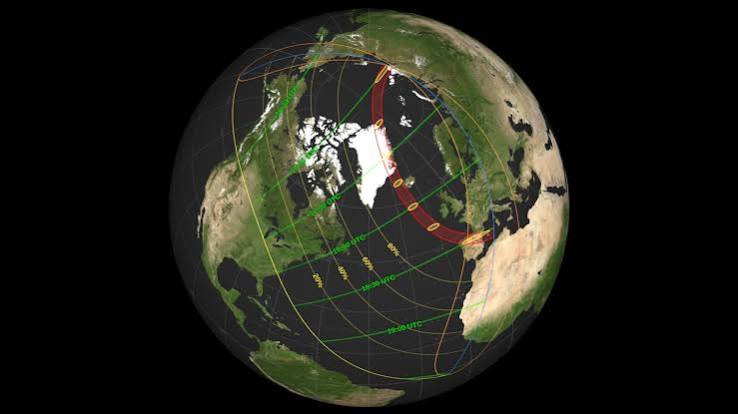
Scientists have mapped the narrow path of totality for the total solar eclipse set to sweep across parts of Greenland, Iceland, northern Spain and northeastern Portugal on Wednesday, August 12.

The celestial event will occur when the Moon passes directly between the Sun and Earth, blocking the Sun’s light and casting its darkest shadow, known as the umbra, across parts of the planet.
The path of totality will stretch about 5,157 miles (8,300 kilometres), beginning over the Arctic coastline at around 1 p.m. ET and ending near the Balearic Islands at about 2:30 p.m. ET.
Observers within the path will experience total darkness for a brief period as the Moon completely covers the Sun. Those outside the path will see a partial eclipse as they fall within the Moon’s lighter outer shadow, known as the penumbra.
The precise path of an eclipse can be calculated years, decades and even thousands of years in advance using astronomical observations, mathematical models and increasingly accurate measurements of the Earth, Moon and Sun.
Eclipse cartographer Michael Zeiler, who has produced eclipse maps for more than two decades, said accuracy is central to creating maps that help people determine where to observe totality.
The Moon’s umbra is only a few hundred kilometres wide because the Moon, despite being about 3,475 kilometres in diameter, is much smaller than Earth. As the Moon travels along its orbit, this narrow shadow moves across the Earth’s surface, creating the path of totality.
Scientists say eclipse maps are already highly accurate, although there is still room for improvement.
Alex Young, a solar physicist and associate director for science communication at NASA’s Goddard Space Flight Center, said current predictions can generally locate the path to within about one to 1.5 kilometres.
He noted that scientists have not yet achieved metre-level accuracy but could eventually reach that level as new solar missions provide more precise data.
Totality will be visible in parts of Greenland, Iceland, northern Spain and northeastern Portugal.
In Reykjavík, Iceland, totality is expected to begin at about 5:48 p.m. local time and last for roughly one minute.
In León, Spain, totality will begin at about 8:28 p.m. local time and last for approximately two minutes.
People across parts of Europe, Africa and North America will also experience a partial eclipse.
The precise experience will vary depending on location. Some eclipse watchers deliberately position themselves near the edge of the path of totality to observe phenomena such as Baily’s Beads, flashes of sunlight that appear through valleys and gaps along the Moon’s uneven edge.
Among those preparing to witness the event is veteran eclipse chaser Michael Zeiler, who is aboard the expedition ship Ocean Explorer heading towards Greenland.
Zeiler hopes to achieve a rare observation: seeing an aurora during solar eclipse totality. He also hopes to catch meteors associated with the ongoing Perseid meteor shower.
Scientists have long studied eclipses because they provide opportunities to observe the Sun and its interaction with Earth’s atmosphere and surrounding space.
The predictable movement of the Earth, Moon and Sun also allows astronomers to calculate eclipse paths far into the future.
Although total solar eclipses follow recurring patterns, they never occur along exactly the same path.
Astronomers use the approximately 18-year Saros cycle to predict recurring eclipse patterns. The cycle was first recorded by ancient Babylonian astronomers.
However, Earth’s rotation means each successive eclipse path shifts by several degrees, according to Philippe Escoubet, a space plasma scientist and spokesperson for the European Space Agency.
The April 2024 total eclipse, which crossed Mexico, the United States and Canada, also showed why continued measurements matter. Scientists found that the Sun’s radius was slightly different from previous estimates, resulting in small changes to some predicted boundaries of the eclipse path.

