


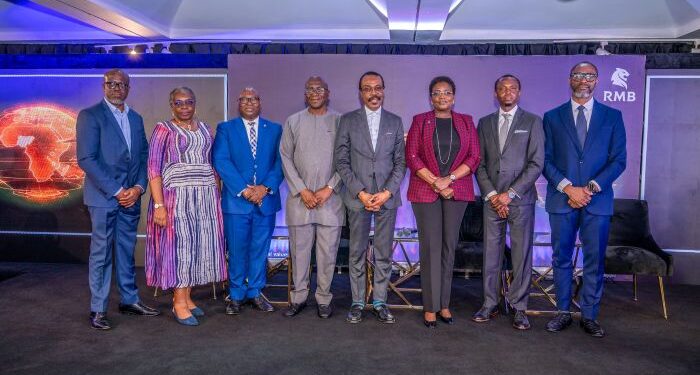
This was the central message at the RMB Nigeria Economic Forum 2026, which convened policymakers, investors, and business leaders to examine Nigeria’s macroeconomic outlook and the expanding opportunities in transition and sustainable finance.

Held under the theme “Charting Nigeria’s Future: Reforms, Resilience and Growth,” the forum featured two highlevel sessions: Building Stability, which explored global and domestic economic dynamics, and Financing the Future, which examined how sustainable finance can support Nigeria’s energy transition and industrial development.
The forum’s keynote address was delivered by renowned economist Bismarck Rewane, Managing Director, Financial Derivatives Company Limited, who underscored the importance of Nigeria’s reform agenda in building economic resilience amid global uncertainty. He highlighted fiscal discipline, monetary stability, exchange rate realignment, and structural transformation as critical pillars for sustainable growth, emphasising that strong institutions, predictable policy frameworks, and accelerated industrialisation remain essential to attracting investment and sustaining long term growth.
The second session featured a presentation on Sustainability and Transition Finance by Tshepo Ntsane, Transactor, Sustainable Finance (Climate and Transition), RMB. Ntsane stressed that Africa’s pathway to a just and inclusive energy transition must carefully balance energy access, security, and environmental sustainability. He noted that transition finance is particularly critical for countries such as Nigeria, where economic diversification and industrial competitiveness depend on pragmatic, wellstructured sustainability strategies.
Ntsane also moderated the Financing the Future panel discussion, which brought together industry leaders including Dr. Adeyemi Adun (Dangote Industries), Eniola Akinsete (Bank of Industry), Eric Idiahi (Evercorp Industries), Ojuru Adeniji (InfraCredit), and Laju Atake (RMB Debt Capital Markets, Nigeria).
Speaking during the panel, Laju Atake highlighted that access to sustainable finance is anchored on the development of clear corporate sustainability strategies and credible sustainable finance frameworks. He noted that institutions such as RMB play a critical role in structuring these frameworks, identifying eligible projects, and connecting issuers to both global and domestic pools of sustainable capital.
Across the sessions, participants agreed that Nigeria’s economic future will be shaped by the country’s ability to sustain reform momentum, strengthen institutions, and adapt swiftly to evolving global economic and environmental dynamics.
