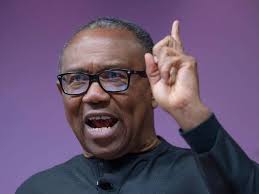
Peter Obi,, former Anambra State Governor and presidential candidate of the Nigeria Democratic Congress (NDC), has challenged the World Bank’s positive outlook on Nigeria’s economic growth, arguing that improving macroeconomic indicators have yet to translate into better living conditions for citizens.

Obi made the remarks on Monday, October 12, 2026, in a statement titled “Celebrating Microeconomic Stability Amidst Increasing Poverty,” published on his official X account.
His comments followed the World Bank’s upward revision of Nigeria’s economic growth forecast to 4.3 per cent in 2026, from 4.0 per cent in 2025. The institution projects annual growth of 4.4 per cent in both 2027 and 2028.
Obi argued that economic performance should be measured by its impact on household welfare, including poverty reduction, job creation and access to essential services.
He maintained that gains in macroeconomic indicators had not produced meaningful improvements in the daily lives of millions of Nigerians.
“So-called ‘economic stability’ has not resulted in higher living standards, improved employment opportunities, and reduction of poverty and inequality across Nigeria,” he said.
The former presidential candidate also questioned the emphasis on rising government revenue, stronger foreign reserves and GDP growth, arguing that these indicators alone do not establish that an economy is stable.
“An economy is not truly stabilised simply because government revenue increases, foreign reserves strengthen, or GDP grows. Stability exists when citizens can afford food, obtain healthcare, provide education for their children, and live with dignity,” Obi added.
He urged the Federal Government to prioritise policies that deliver measurable improvements in citizens’ welfare rather than relying solely on favourable economic statistics to assess the success of its reforms.
In its October 2026 Africa Economic Update, the World Bank attributed Nigeria’s stronger medium-term growth prospects to improving economic conditions, renewed investor confidence and an expected recovery in private-sector investment.
The improved outlook forms part of a broader upward revision of growth projections for Sub-Saharan Africa. The Bank raised its 2026 forecast for the region by 0.3 percentage points to 4.3 per cent, compared with estimated growth of 4.1 per cent in 2025.
The revision reflects stronger economic performance across several countries, including Nigeria, Angola, Ethiopia and Zambia.
However, the World Bank cautioned that economic expansion across the region remains insufficient to significantly reduce extreme poverty or create enough jobs for its growing workforce.