


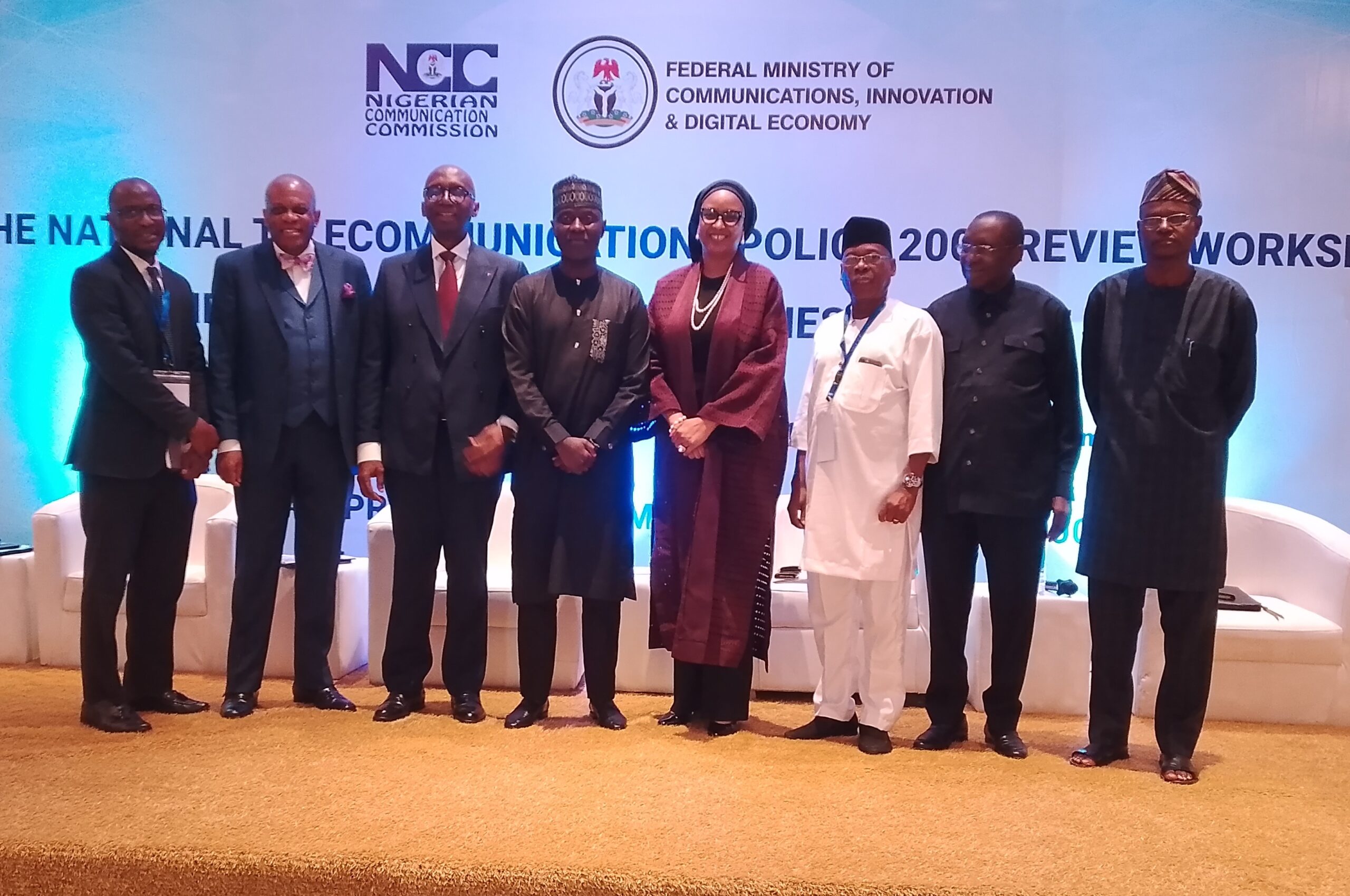
Dr. Aminu Maida, Executive Vice Chairman/CEO of the Nigerian Communications Commission (NCC), has said Nigeria’s ongoing review of the National Telecommunications Policy (NTP) 2000 is a strategic national initiative capable of unlocking major economic benefits, including an additional two per cent growth in GDP, the creation of more than two million jobs, and nearly ₦2 trillion in additional tax revenue by 2030.

Speaking at the NTP 2000 Review Workshop in Lagos on Wednesday, Dr Maida described the proposed policy direction as more than a routine sector review, saying it represents a national economic transformation agenda aimed at accelerating digital adoption across critical sectors such as agriculture, manufacturing, transportation, and public services.
Referencing industry projections, including analysis by the GSMA, Dr Maida noted that deeper digitalisation could significantly expand Nigeria’s economy by 2030. “The choices we make today will determine whether Nigeria fully captures the productivity gains of the digital economy or continues to operate below its potential,” he said.
The workshop attracted senior government officials and key stakeholders, including representatives from the Federal Ministry of Communications, Innovation and Digital Economy, National Information Technology Development Agency (NITDA), Nigeria Data Protection Commission (NDPC), and the West Africa Telecommunications Regulators Assembly, alongside industry leaders, former regulators, and development partners.
Dr Maida also stressed the importance of stronger regulatory collaboration with institutions such as the Central Bank of Nigeria and the Federal Competition and Consumer Protection Commission to ensure policy coherence across Nigeria’s evolving digital ecosystem.
He added that the outcome of the policy review would play a critical role in expanding Nigeria’s tax base, improving public service delivery, creating jobs, and positioning the country as a leading digital economy in Africa by 2030.
In her keynote address, Hadiza Bala Usman, Special Adviser to President Bola Ahmed Tinubu on Policy and Coordination, said the review of the NTP 2000 presents an opportunity for Nigeria to reposition its digital economy and align telecommunications development with broader national objectives.
According to her, modern telecommunications policy must address key issues such as broadband expansion, affordability, digital inclusion, infrastructure resilience, consumer protection, cybersecurity, digital skills, data governance, innovation, and emerging technologies.
Adaobi Nwankwo, Head of Innovation at the NDPC, commended the NCC’s initiative and highlighted the central role of data in the digital economy. She advocated “privacy by design,” which embeds privacy protections from the outset, and cited the recent Memorandum of Understanding between the NDPC and NCC as a strong example of inter-agency collaboration.
Also speaking, Oladejo Olawunmi, representing NITDA Director General Kashifu Inuwa Abdullahi, said most of the short- and medium-term objectives of the original policy had been substantially achieved. He reaffirmed NITDA’s commitment to working with the NCC on initiatives including universal access, the transition from IPv4 to IPv6, and the National Digital Literacy Framework.
During a panel session, H. Sama Nwana argued that although the 2000 policy framework and the Nigerian Communications Act laid a strong foundation for liberalisation and growth in the telecommunications sector, the digital landscape has changed significantly. According to him, the world of 2026 is far more interconnected, complex, and data-driven, requiring Nigeria to rethink how it governs the internet economy.
Similarly, Ikechukwu Nnamani, Managing Director, Digital Realty Nigeria, said the review of the NTP 2000 would help create a framework that supports innovation, reduces costs, improves infrastructure deployment, attracts hyperscale investments, and strengthens Nigeria’s competitiveness in the global digital economy.

