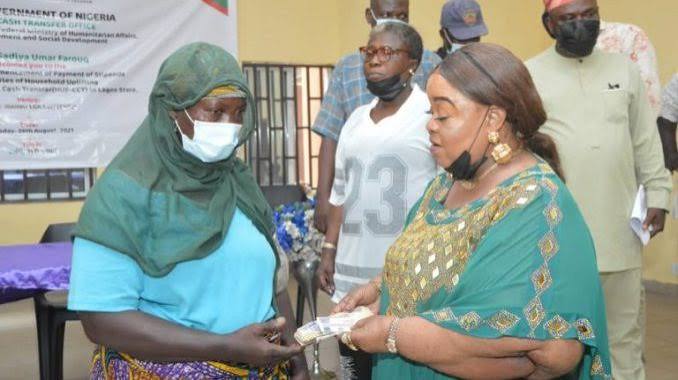
The Federal Government says it has disbursed more than N600 billion to slightly over 10 million households in three years. It is a significant claim, one that, if properly documented, could represent one of the largest social protection interventions in Nigeria’s recent history.

But the size of the figure demands more than a ministerial declaration. It demands transparency, documentation and independently verifiable evidence.
The central question is simple: where is the evidence?
The government should publish a comprehensive breakdown showing how the N600 billion was disbursed, when the payments were made, how many households benefited in each state and how much each household received. Nigerians should also be told how many beneficiaries received multiple payments and how the government ensured that such payments were legitimate rather than duplication or leakage.
The claim of reaching more than 10 million households is particularly important because Nigeria has struggled for years with the credibility and administration of its social intervention programmes. Questions around beneficiary selection, political interference, ghost beneficiaries and weak monitoring have repeatedly raised concerns about whether public funds reach the people for whom they are intended.
A single headline figure of N600 billion does not tell Nigerians enough.
If more than 10 million households were reached, the government should be able to provide a clear audit trail. That should include the total number of beneficiaries, the geographical distribution, the amount paid per beneficiary, payment dates, the channels used for disbursement and the administrative cost of running the programme.
The government does not necessarily need to publish sensitive personal information about beneficiaries. Names, bank details, NINs and other private data should remain protected.
But anonymised and aggregated information can be published without compromising beneficiaries’ privacy.
For example, Nigerians should be able to see how much was paid in Lagos, Kano, Kaduna, Rivers, Borno and every other state. They should know the number of households reached in each state and the total amount transferred.
More importantly, the figures should be subject to independent audit.
Another critical question concerns the National Social Register.
Who compiled the list? Who verified the households? How frequently is the database updated? How are deceased persons, duplicated records and people who no longer qualify removed?
The government’s decision to link beneficiaries to the National Identification Number could strengthen verification, but it also makes transparency around the process even more important.
If NIN is now being used to validate beneficiaries, the government should explain how many records were rejected, how many duplicates were discovered and how many suspected fraudulent claims were stopped.
These are not unreasonable demands. They are basic accountability questions when hundreds of billions of naira in public resources are involved.
The government’s new HOPE-SP programme, targeting about 7.6 million vulnerable households with a one-off N40,000 payment, makes the demand for transparency even more urgent.
At N40,000 per household, payments to 7.6 million households would amount to N304 billion.
That is a substantial public expenditure.
Before the programme expands, the government should publish clear eligibility criteria, explain how beneficiaries will be selected and provide a mechanism through which Nigerians can verify that the programme is operating as claimed.
There should also be a public complaints and redress system that allows excluded or wrongly listed households to challenge decisions.
There is another issue that should not be lost in the debate.
Cash transfers are important, particularly during periods of economic hardship. But the ultimate measure of a poverty-reduction programme should not simply be how much money was distributed or how many people received it.
The government should demonstrate what changed for beneficiaries.
Did household income improve? Did food security improve? Were children able to remain in school? Did beneficiaries establish businesses or acquire productive assets? Did households become less dependent on government assistance?
If the stated objective is to move people from vulnerability towards economic self-reliance, the government must publish evidence showing whether that transition is happening.
Demanding proof of government spending should not be interpreted as opposition to social protection.
Quite the opposite.
Transparent reporting protects legitimate beneficiaries and strengthens public confidence in programmes designed to help them.
If the Federal Government has indeed disbursed more than N600 billion to more than 10 million households, it should have little difficulty demonstrating how the money moved from the public purse to beneficiaries.
The government should therefore publish the figures, datasets in appropriately anonymised form, audit reports, state-by-state breakdowns and independent verification results.
N600 billion is too much money to remain a headline figure.
Nigerians deserve to know not merely that the money was supposedly disbursed, but where it went, who received it, how the beneficiaries were verified and what difference it made.
Until that evidence is made available, the appropriate response to the N600 billion claim is not outright rejection but serious scrutiny and a demand for proof.