
By Aderemi Ogunpitan

The recent inauguration of a ₦40.17 billion CCTV control centre for the Third Mainland Bridge by the Federal Government invites a necessary and sober review, not out of cynicism, but out of responsibility to public accountability. Major infrastructure investments deserve calm scrutiny, especially when they are presented under a single label that may not fully describe what is being delivered.
The Third Mainland Bridge spans approximately 11.8 kilometres. By global standards, CCTV deployment for linear infrastructure of this nature is not uncommon, particularly where safety, traffic management and security are concerns.
However, international best practice assesses such projects by disaggregating costs: cameras, transmission networks, power supply, civil works, control rooms, operations and maintenance.
Publicly available benchmarks provide useful context. In central London, including the West End under Westminster City Council, high-spec public CCTV deployments covering dense urban districts have been delivered for sums in the range of hundreds of thousands of pounds, with borough-wide operating budgets running into low single-digit millions annually. These systems benefit from existing power, fibre networks, buildings and shared monitoring centres.
Even allowing for harsher marine conditions, corrosion-resistant equipment and standalone infrastructure, the order of magnitude difference remains notable.
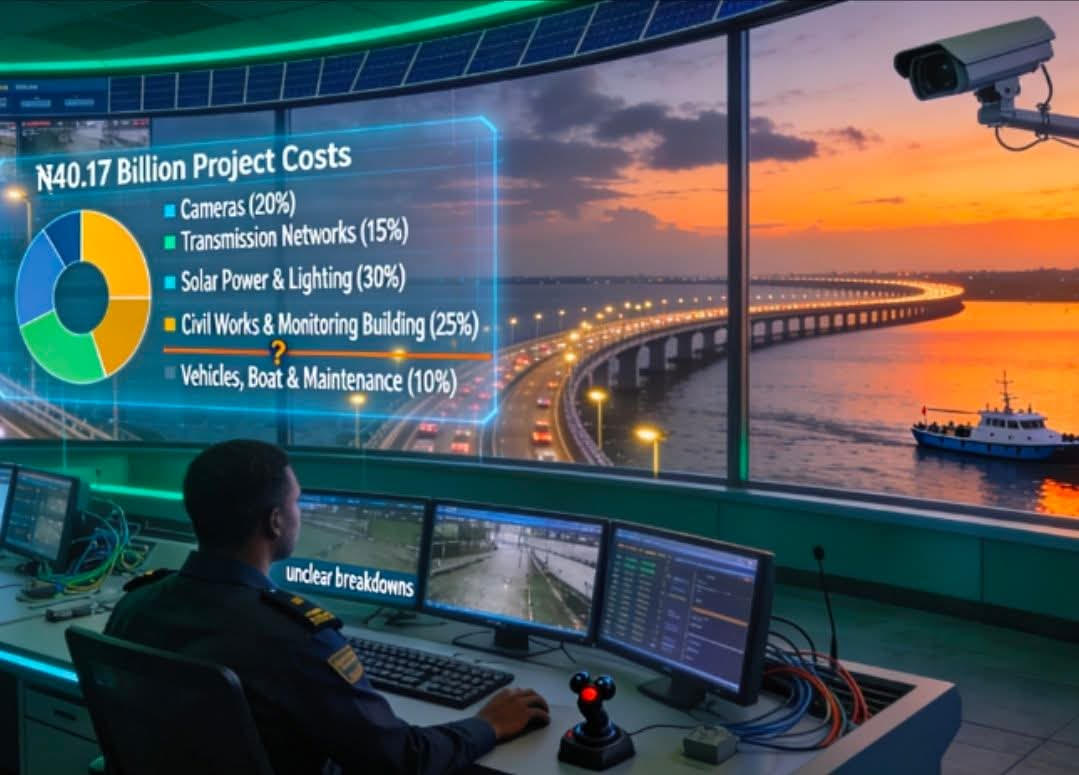
In the case of the Third Mainland Bridge project, the announced contract scope extends beyond surveillance cameras. It includes solar street lighting, independent power generation, a dedicated monitoring building, vehicles, a surveillance boat and ancillary infrastructure. This suggests that the ₦40 billion figure represents a bundled security and infrastructure package rather than a CCTV system in the narrow technical sense. This distinction matters.
When complex, multi-asset projects are presented under a single headline, meaningful evaluation becomes difficult. In Nigeria, we do this to hide the real numbers.
What remains unclear from public disclosures is the breakdown of costs: the number and specification of cameras deployed, unit costs, network architecture, the proportion attributable to lighting and power infrastructure, and whether long-term operations and maintenance are embedded in the contract sum. Without these details, it is not possible to determine value for money or compare like-for-like with international systems.
Audit culture is not adversarial. It exists to protect institutions as much as taxpayers by ensuring clarity, comparability and trust. Transparent disclosure would allow citizens to understand whether the investment reflects local realities, long-term operational needs and reasonable pricing, or whether scope and terminology have been conflated in ways that obscure proper evaluation.
Infrastructure security is important. So is confidence in public procurement. The most effective way to secure both is not through rhetoric, but through clear, itemised information that allows informed judgment.
In projects of this scale, transparency is not optional; it is the final deliverable.
Aderemi Ogunpitan is an award-winning TV producer and CEO, IBST Media.