


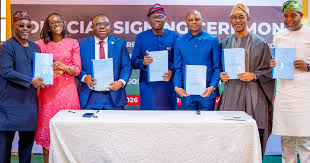
Lagos State has signed new power agreements with three independent power producers (IPPs) to scale electricity generation capacity to between 200MW and 400MW over the next few years.

The deals, comprising Power Purchase Agreements (PPAs) and concession arrangements, were finalised at Lagos House, Marina, with Mainland Power Limited, Fenchurch Power Limited (in partnership with Aggregate Utilities Limited), and Viathan Engineering Limited.
The projects form part of Lagos’ embedded power programme and cover three of the four IPPs under the initiative, aimed at improving electricity reliability and reducing dependence on the national grid.
Governor Babajide Sanwo-Olu, who presided over the signing, described the agreements as a major step in the state’s energy reform drive.
“These partnerships reflect our commitment to delivering reliable power to homes, businesses, and critical infrastructure,” he said.
Biodun Ogunleye, Commissioner for Energy and Mineral Resources, said the new framework is designed to scale generation from less than 60MW currently to as much as 400MW within two to three years.
Unlike previous arrangements, the new contracts eliminate “take-or-pay” and “deemed energy” clauses. Payments will now be based strictly on metered electricity delivered, introducing a more performance-driven model.
Ogunleye said the approach would attract private investment while improving transparency, cost efficiency, and accountability in the power value chain.
Under the arrangements, Mainland Power will continue supplying electricity to parts of Ikeja, Oshodi, Anthony, and key public institutions such as LASUTH.
The Akute IPP is being rehabilitated to support water infrastructure and nearby communities, while Viathan-linked plants on Lagos Island will provide hybrid power solutions for government and commercial assets.
The state is also introducing dual power supply systems for critical infrastructure to improve reliability.
Lagos has intensified efforts to build a self-sustaining electricity market, backed by regulatory changes that allow states to manage their own power sectors.
The shift has opened the door for increased private sector participation, with new projects such as a planned 50MW gas-fired plant at Ogba Industrial Estate expected to further strengthen supply to businesses.
With the latest agreements, Lagos is positioning itself to significantly expand power generation and reduce grid constraints, key to sustaining economic growth in Nigeria’s commercial hub.

