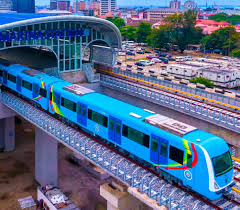
The Lagos Rail Mass Transit (LRMT) Blue Line has transported more than eight million passengers in just over 1,000 days of commercial operations, as construction of its Phase II extension recorded a major breakthrough with the installation of its first precast T-beam.

The update was announced on Thursday by the China Civil Engineering Construction Corporation (CCECC) Nigeria, the contractor responsible for building, operating and extending the rail line.
CCECC said the Blue Line has safely carried more than eight million commuters since passenger services began in September 2023, underscoring the growing role of rail transport in easing Lagos’ traffic congestion.
The company also confirmed the successful installation of the first precast T-beam for the Mile 2–Okokomaiko Phase II extension, marking the transition from foundation works to the construction of the elevated railway superstructure.
A precast T-beam is a reinforced concrete component used to support elevated rail bridges. Its installation signals significant progress, as it forms part of the bridge deck that will carry the railway tracks.
CCECC described the achievement as another important engineering milestone in the expansion of the Blue Line.
The Lagos Blue Line is a 27-kilometre standard-gauge electric railway being developed by the Lagos State Government through the Lagos Metropolitan Area Transport Authority (LAMATA).
Its first phase, a 13-kilometre stretch linking Marina and Mile 2, has become a critical alternative to road transport since commercial operations began.
The ongoing 14-kilometre Phase II extension will connect Mile 2 to Okokomaiko, with new stations planned at Festac, Alakija, Trade Fair, Volkswagen, LASU and Okokomaiko.
The project also includes a 400,000-square-metre maintenance depot at Okokomaiko, while the existing Mazamaza Bridge will be replaced and new bridges constructed at Satellite and LASU to accommodate the rail corridor.
The Blue Line is part of the Lagos State Strategic Transport Master Plan, which has expanded from six to 11 rail lines and one monorail to create an integrated urban rail system.
Currently, only the first phases of the Blue and Red Lines are operational, while work continues on their extensions. The state is also considering extending the Red Line into Ogun State to improve regional connectivity.
In June, the Nigerian Railway Corporation (NRC) granted LAMATA a 15-year rail operating licence covering the Blue Line, Red Line and future rail projects. Earlier this month, LAMATA and CCECC also signed an agreement to establish a Railway Training Centre to develop the skilled workforce needed to support Lagos’ rapidly expanding rail network.