


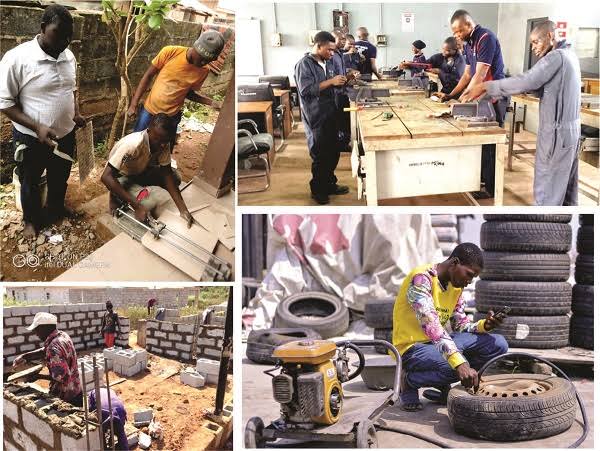
The Industrial Training Fund (ITF) has raised concerns over Nigeria’s skills gap in the construction industry, warning that the shortage of adequately trained artisans is forcing the country to rely on workers from neighbouring African countries for specialised finishing jobs.

Afiz Ogun, Director-General of the ITF, said Nigeria’s dependence on artisans from countries including Togo and Ghana was particularly evident in areas such as tiling, plaster of Paris (POP) and other finishing works.
Ogun spoke in Abuja at a joint press conference and groundbreaking ceremony for the second National Industrial Manpower Summit (NIMS 2.0).
He said the situation reflected a broader challenge in Nigeria’s technical and vocational skills ecosystem, where many artisans lack the training required to meet modern construction standards.
According to him, the country cannot achieve sustainable economic growth while depending on foreign workers for skills that Nigerian youths should be able to provide.
Ogun disclosed that the ITF had trained about 2,000 artisans since 2024 and was continuing to expand its skills development programmes.
He said the Fund’s World Skills Academy in Maitama, Abuja, provides a permanent facility where artisans and trainers can acquire practical skills and improve their capacity.
The ITF boss also expressed concern over the quality of trainers available at some private training centres across the country.
“It is a pity that a lot of private training centres lack quality trainers,” Ogun said, stressing that the World Skills Academy was designed to help address the problem.
He explained that trainers from different institutions could use the academy to upgrade their skills and subsequently transfer the knowledge to other trainees.
Ogun said the ITF was working with agencies and parastatals under the Ministry of Industry, Trade and Investment to strengthen skills acquisition programmes nationwide.
The objective, he said, was to ensure that more Nigerian youths acquire practical skills that can make them competitive both locally and internationally.
He added that President Bola Tinubu had recognised the economic importance of artisans and was giving them greater visibility within the government’s economic agenda.
Ogun commended the President for restoring confidence among artisans and recognising their role in nation building and economic development.
Oluwatosin Ayinde, Senior Special Assistant to the President on ITF, disclosed that the Federal Government provided ₦1 million each to 50 graduating artisans in 2025, representing a total intervention of ₦50 million.
He said the government planned to improve on the initiative this year.
The support, he explained, was aimed at helping trained artisans establish or strengthen their businesses after completing their programmes.

