


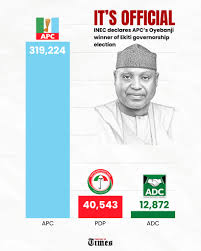

Oyebanji secured 319,224 votes to defeat his closest rival, Olumayokun Oluyede of the Peoples Democratic Party (PDP), who polled 40,533 votes, and Dare Bejide of the African Democratic Congress (ADC), who scored 12,872 votes.
Prof. Adenike Oladiji, Vice-Chancellor of the Federal University of Technology, Akure, Returning Officer for the election, announced the result at the State Collation Centre in Ado-Ekiti.
“Therefore, I, Adenike Oladiji, the Returning Officer for the 2026 Ekiti Governorship Election, hereby declare that Oyebanji Abiodun Abayomi, having satisfied the requirements of the law, is duly elected and returned as Governor of Ekiti State,” she said.
The results showed a dominant performance by the incumbent governor, who won in all 16 local government areas, reinforcing the APC’s stronghold in the state.
Key local government results indicated solid margins in several areas, including Irepodun/Ifelodun, where Oyebanji polled 29,278 votes, Ekiti West with 28,258 votes, Ikole with 26,508 votes, and Ekiti East with 26,359 votes.
The wide margin between the APC candidate and his opponents underscored what analysts described as a strong voter endorsement of the incumbent administration.
While the election concluded with a clear outcome, data from INEC indicated that voter turnout remained moderate across the state.
The exercise was conducted across the 16 local government areas under close monitoring by electoral officials, security agencies, and observers, with results collated at the state level before the official declaration.
The poll was widely viewed as a key test of political strength in Ekiti State, particularly for the ruling APC and the performance of Governor Oyebanji since assuming office in 2022.
Oyebanji, who was first elected in 2022 and sworn in on October 16 of the same year, will now serve a second term following his re-election.
His administration has focused on infrastructure development, education, healthcare, agriculture, and economic reforms aimed at improving service delivery and boosting growth in the state.
The fresh mandate is expected to allow the governor to consolidate ongoing projects and advance new policy initiatives across key sectors of the economy.
The outcome further strengthens the APC’s political position in the South-West region and reinforces the party’s influence ahead of future electoral cycles.
It also signals continuity in Ekiti’s governance structure, with voters largely opting to retain the incumbent leadership.
In August 2025, Oyebanji dissolved the State Executive Council in what was seen as part of a broader repositioning of his administration ahead of the election.
With the election concluded, attention is now expected to shift toward governance priorities and the implementation of development plans under his second term mandate.
INEC’s declaration formally brings the contest to a close, confirming Oyebanji as the duly elected governor of Ekiti State.

