


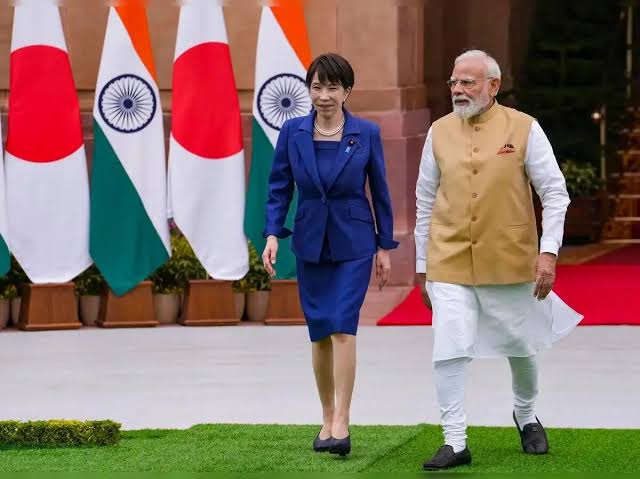
India and Japan have significantly strengthened their strategic and economic partnership, signing more than 100 business agreements as both nations seek to reduce their dependence on China and bolster regional security.

The agreements were concluded during Japanese Prime Minister Sanae Takaichi’s first official visit to India, where she held talks with Prime Minister Narendra Modi aimed at expanding cooperation in key sectors, including semiconductors, energy security and critical mineral supply chains.
The renewed partnership reflects growing concerns in both countries over China’s increasing economic and military influence in the Indo-Pacific.
Relations between Asia’s second- and third-largest economies gained momentum under former Japanese Prime Minister Shinzo Abe, who viewed India as a crucial partner in preserving a rules-based international order amid China’s rise. While Abe laid the strategic foundation, Takaichi is now seeking to translate that vision into practical economic and security cooperation.
The timing of the visit is significant. Earlier this week, China expanded export controls affecting Japanese companies, reinforcing Tokyo’s push to diversify supply chains and strengthen economic resilience through partnerships with countries such as India.
Alongside the business deals, both leaders pledged closer cooperation in defence and security as they continue to manage territorial disputes with China.
Analysts also believe Takaichi and Modi exchanged views on dealing with a more inward-looking United States under President Donald Trump, whose administration has increasingly prioritised domestic interests over traditional alliance-building. The recent decision by Washington to rename its military headquarters from “Indo-Pacific Command” back to “Pacific Command” has been interpreted by some observers as signalling a shift in strategic emphasis.
Unlike the United States, Japan is expected to adopt a more pragmatic approach toward India’s continued defence and energy ties with Russia. Tokyo itself remains partly dependent on Russian energy supplies and is therefore less likely to pressure New Delhi over its longstanding relationship with Moscow.
The visit also highlighted the growing personal rapport between Takaichi and Modi, echoing the close relationship the Indian leader enjoyed with the late Shinzo Abe.
Speaking after bilateral talks, Takaichi said she and Modi had pledged “to work together as brother and sister,” underscoring the warmth of the evolving partnership.
The expanding India-Japan alliance is increasingly viewed as one of the pillars of the Indo-Pacific strategic architecture, combining economic cooperation, technological collaboration and security coordination at a time of heightened geopolitical competition with China.
