By Elvis Eromosele

There is a quiet force holding much of Nigeria together. It is visible before dawn in the markets, in kitchens where meals are stretched to feed families, in the small shops that keep neighbourhoods moving, in the women’s associations where ideas take shape, and in the community meetings where everyday problems are sorted out. This force is the Nigerian woman.
The contribution of the Nigerian woman to the country is immense. It is far bigger than the support she gets in return, whether in opportunity, resources or institutional backing. If Nigeria truly wants a stronger, more productive and inclusive country, empowering women must be mainstream. It has to sit at the centre of the national agenda. Today, making a difference, impacting lives and building the nation is not just a neat phrase. It is already happening in communities across the country.
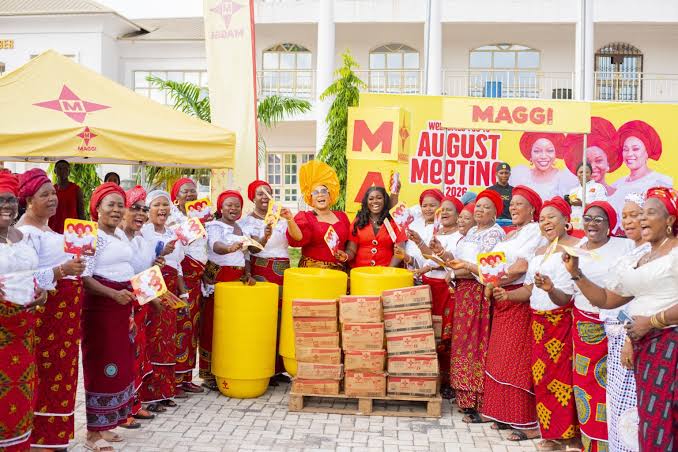
One clear example is MAGGI’s 2026 August Meeting programme in the South-East.
Now, the August Meeting has long given women in the region a valued space to reconnect, share ideas and talk about the issues that touch their families and communities. It is rooted in culture. Yet its value reaches far beyond celebration.
In 2026, MAGGI scaled up its involvement, reaching 19,670 women across the five South-East states. The effort worked with 30 women’s associations and included five market activations. Participation more than doubled from the previous year, making it the brand’s largest August Meeting engagement so far.
The gatherings mixed celebration with practical value. There were cooking competitions, music, gifts and appearances by Ruby Ojiakor, Blessing Obasi and Blessing Onwukwe. Food remained the centre of the experience. Women tried new ways with familiar dishes and used the competitions to show skill and creativity.
Nutrition formed another core part. Sessions covered balanced diets, the importance of micronutrients such as iron, and realistic ways to plan family meals on limited budgets. Participants also learned how fortified foods, including iron-fortified MAGGI products, can fit into a varied diet.
This mix matters. Real engagement with women should do more than put a brand in front of them. It should open doors to participation, learning, connection and practical benefit. A woman who picks up a new skill can use it at home or in her business. A woman whose enterprise grows can employ others. A woman who gains useful knowledge about money or nutrition can pass it on. A woman who takes part in community decisions can shape outcomes beyond her own household.
Nigeria therefore needs steady investment in women’s skills, entrepreneurship, financial inclusion, health, nutrition, digital access, leadership and market access. It also needs to acknowledge the vast amount of unpaid and often invisible work women carry out every day.
Indeed, across the country women run micro and small businesses, trade, process food, offer services, care for families and keep households running. Much of this sits outside the formal economy, yet its contribution is real and measurable. The challenge is how to turn that contribution into greater economic opportunity.
This is where the August Meeting experience offers a useful lesson. Women already have networks. They belong to associations, cooperatives, religious groups, professional bodies, market organisations and community structures. When these networks are deliberately strengthened, they become powerful channels for knowledge, enterprise and social change.
MAGGI’s approach worked with an existing cultural institution rather than trying to invent a new community. This is significant. Effective engagement usually starts by meeting people where they already are. For a brand that has been part of Nigerian households for sixty years, the link with food and with women is especially natural. MAGGI has grown alongside generations of Nigerians, remaining present in kitchens while staying connected to the cultural and social spaces around food, family and community.
As Funmi Osineye, Category Manager, Culinary, Nestlé Nigeria, noted, August Meeting gives women an important space to come together, learn from one another and share experiences. This observation points to a wider truth about brand relevance. A brand’s relationship with people deepens when it understands not only what they buy, but the culture, hopes and daily realities that shape their lives.
For MAGGI the kitchen is an obvious meeting point. Yet the woman in that kitchen is often also an entrepreneur, caregiver, professional, farmer, trader, community organiser or leader. Her needs stretch far beyond the products on the shelf.
The next stage of women’s empowerment in Nigeria must move past inspiration. Women need affordable finance, reliable markets, technology, infrastructure and skills that turn into income. They need pathways from subsistence activities into sustainable businesses. And they need institutions that support them consistently, not programmes that vanish once a campaign ends.
This is especially urgent while households and small businesses continue to face economic pressure. When money is tight, women are frequently the ones expected to stretch it further, feeding families, managing household costs and finding extra ways to earn.
The 19,670 women reached through MAGGI’s 2026 August Meeting engagement show what scale can look like. The longer-term opportunity is to make sure the knowledge, relationships and experiences created during those gatherings keep generating value long after the events themselves.
This calls for government, businesses, financial institutions, civil society and communities to work together. It also requires a shift in mindset, from asking how society can “help women” to asking how it can remove the barriers that stop women from fully using their abilities.
At one level, the story of August Meeting is about food, culture and community. At another, it is about what becomes possible when women have spaces to gather, take part, learn, connect and affirm their collective strength.
MAGGI’s engagement demonstrates how an established consumer brand can leverage a trusted cultural platform to deepen its connection with women while championing culinary creativity. The brand effectively combines hands-on nutrition education with a sense of community spirit to build lasting relationships with its audience.
Nigerian women can make a difference. The task now is to ensure the systems around them make that difference easier, larger and more lasting.
Eromosele, a corporate communications expert and sustainability advocate, writes via elviseroms@gmail.com.