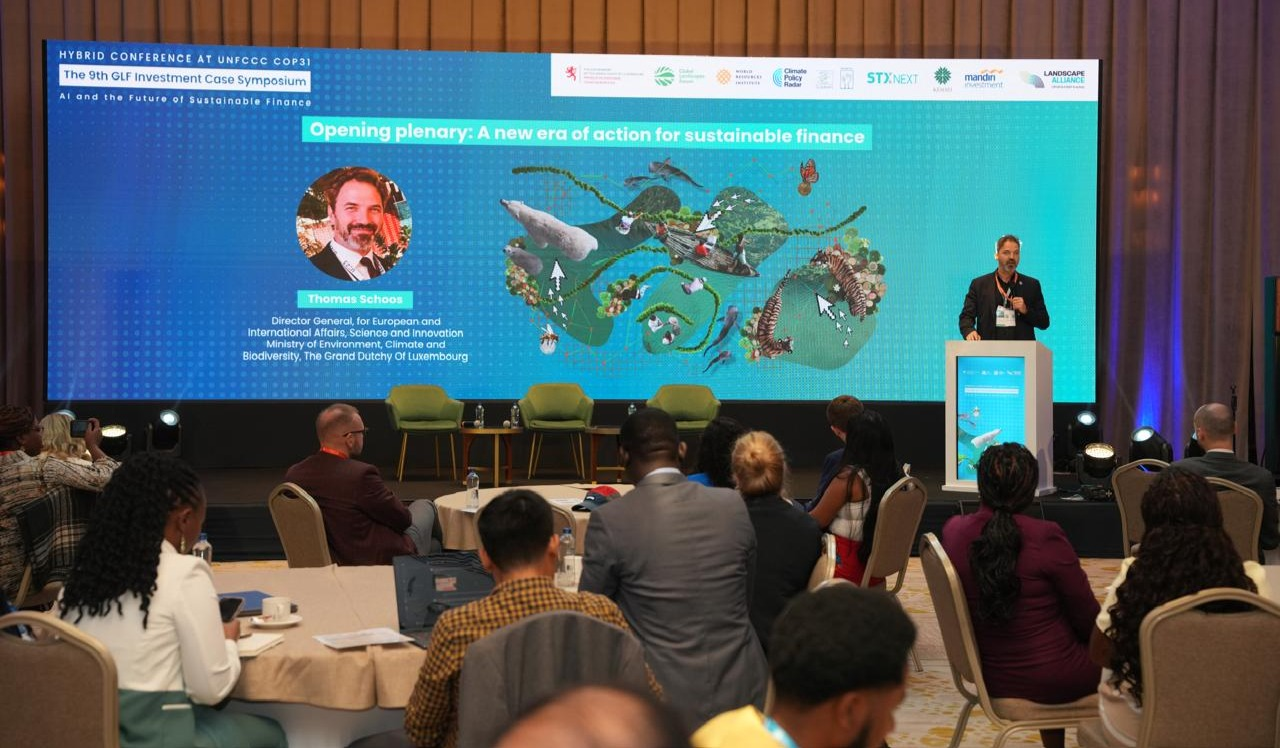
The 9th Global Landscapes Forum (GLF) Investment Case Symposium has called for a fundamental shift in global financing, urging investors, governments and development institutions to prioritise investments that strengthen ecological resilience, protect livelihoods and promote sustainable economic growth.

The symposium, held alongside the United Nations Climate Change Conference (COP31) in Antalya, Türkiye, brought together nearly 1,800 participants from 133 countries, including 147 COP delegates, to explore innovative financing models for climate action, biodiversity protection and sustainable land use.
Organised by the Global Landscapes Forum and presented by the Government of Luxembourg, the event convened leaders from the financial sector, artificial intelligence (AI), government, research institutions, private businesses and civil society to examine how capital can be channelled towards solutions that deliver measurable environmental and social impact.
While discussions at COP31 highlighted the difficulty of turning the priorities of least developed countries into bankable projects, the symposium focused on practical investment opportunities and ways to bridge the gap between global financing and locally driven solutions.
Its programme examined emerging technologies, AI-enabled decision-making, innovative financing mechanisms and cross-sector partnerships. A major highlight was the introduction of Rio Changemakers, a new digital global marketplace designed to connect investors with initiatives delivering environmental and social impact.
Kamal Prawiranegara, Director and Co-founder of the Global Landscapes Forum, said sustainable finance should ultimately become the standard for all financial activities rather than remain a separate investment category.
He argued that all financing should contribute to creating landscapes that are productive, prosperous, equitable and resilient, describing Rio Changemakers as one of the initiatives helping to make that transformation possible.
A major feature of the symposium was the live assessment of three projects by potential investors, providing project developers with feedback on their financial viability, investment readiness and potential impact.
The projects included Satellites on Fire, an Argentine initiative offering subscription-based, AI-powered wildfire detection; Kenya’s Ol Pejeta Conservancy, which combines wildlife tourism and sustainable agriculture to protect endangered species and restore habitats; and Botswana-based Viva Organica, which commercialises organic biofertilisers produced from recycled waste.
Ken Kimani, Director of Corporate Affairs at Ol Pejeta Conservancy, highlighted the importance of water security to ecological protection and sustainable livelihoods.
He disclosed that the conservancy had developed a 10-year water management plan focused on storage and distribution, with plans to deploy AI to monitor water consumption and assess the impact of water availability across its 90,000-acre estate and the wider Laikipia landscape.
According to him, reliable water supplies are essential not only for wildlife but also for livestock and downstream communities.
Other organisations seeking investor feedback included Luxembourg-based climate venture capital fund Satgana, the $80 million-target Acumen Climate Action Pakistan fund, Bangladesh’s Shakti Foundation and Equilibrium Climate Capital, which operates across Asia and the Middle East and North Africa.
The symposium also examined financing opportunities in resilient food systems, drawing on lessons from the Food Systems, Land Use and Restoration (FOLUR) Impact Programme.
The seven-year initiative, which is concluding its work, has supported sustainable practices across major agricultural value chains, including livestock, cocoa, coffee, maize, palm oil, rice, soybeans and wheat.
Fazil Dusunceli, Agriculture Officer at the Food and Agriculture Organisation’s Plant Production and Protection Division, emphasised the importance of involving local communities and institutions in designing and implementing agricultural projects.
He said collaboration among research institutions, agricultural extension services and farmer organisations in Türkiye had helped strengthen project outcomes and build lasting relationships among stakeholders.
Peatland conservation was another major focus. Although peatlands cover only three to four per cent of the Earth’s land surface, they store nearly one-third of the carbon contained in the world’s soil, making them critical to climate stability, water security and livelihoods.
Dianna Kopansky, Coordinator of the United Nations Environment Programme’s Global Peatlands Initiative, called for a broader approach to financing peatland conservation.
She urged investors to move beyond funding isolated restoration projects towards financing comprehensive peatland transitions through blended finance, stronger protection measures and investment portfolios that can attract institutional capital.
The symposium also highlighted the economic challenges facing communities that depend on forests and other natural resources.
The Rights and Resources Initiative (RRI), in collaboration with the University of Notre Dame, launched what it described as the first-ever global livelihoods baseline, developed with guidance from rightsholder leaders.
The study initially covers Brazil, Colombia, the Democratic Republic of the Congo, Indonesia, Nepal and Peru. Together, these countries account for approximately half of the world’s tropical forest areas.
The initiative aims to provide governments, investors, donors, local communities and civil society organisations with evidence to support policies and investments that enable communities to generate sustainable livelihoods while protecting their territories.
Bryson Ogden, Director of the Rights and Livelihoods Programme at RRI, noted that securing land rights alone does not guarantee economic opportunities for local communities.
He said access to finance, enterprise development, capacity building and the preservation of traditional knowledge were equally important in enabling communities to achieve their development aspirations.
Youth participation and funding models that respect community priorities also featured prominently.
Swetha Stotra Bhashyam, an affiliate of Synchronicity Earth Youth and co-author of the Ecologies of Empowerment report, called on funders to adopt flexible, long-term financing arrangements and build partnerships based on mutual accountability.
The role of artificial intelligence in directing investment towards environmental and social solutions was another key discussion point.
Speakers examined how AI could improve risk assessment, support decision-making and address barriers to financing locally led initiatives. However, they cautioned against treating technology as a standalone solution to structural challenges in sustainable finance.
Éliane Ubalijoro, Chief Executive Officer of Landscape Alliance and Director General of the World Agroforestry Centre (ICRAF), said AI could assess financial risks, map forests and calculate investment returns but could not independently determine how risks should be shared, establish land rights or negotiate equitable benefit-sharing arrangements.
She warned that relying exclusively on data-rich, low-risk projects could deepen existing inequalities by excluding Indigenous Peoples and local communities whose initiatives may lack the documentation and financial structures demanded by conventional investors.
Ubalijoro stressed that these communities must participate in shaping AI systems and share in the value they generate.
She said the objective should be to make sustainable finance more intelligent, accessible and equitable.
Thomas Schoos, Director General of European and International Affairs, Science and Innovation at Luxembourg’s Ministry for the Environment, Climate and Biodiversity, said stronger connections between public finance, private capital and local project developers were necessary to unlock investment.
He described Rio Changemakers as a platform that could help align the interests of investors, governments and project developers while strengthening the infrastructure for financing sustainable development.
The symposium concluded with a shared message that environmental commitments must translate into practical investments capable of delivering measurable benefits for people, nature and the economy.
Participants agreed that financing ecological resilience, protecting livelihoods and strengthening locally led initiatives are essential to building a more sustainable and inclusive global economy.
Recordings of the 9th GLF Investment Case Symposium are available to participants through the event’s press access, while Rio Changemakers provides an avenue for investors and project developers to explore potential collaborations.