


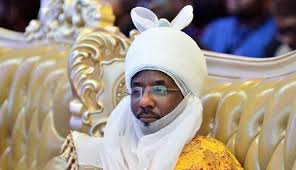
Muhammadu Sanusi II, Emir of Kano and former Central Bank of Nigeria (CBN) Governor, has strongly cautioned West African leaders against rushing the adoption of the proposed “ECO” common currency.

Speaking at a policy dialogue organised by the National Institute for Legislative and Democratic Studies (NILDS) in Abuja, Sanusi warned that a monetary union cannot succeed without economic convergence, fiscal discipline, and genuine political commitment.
Sanusi emphasised that while a common currency could reduce transaction costs and boost regional competitiveness, the Economic Community of West African States (ECOWAS) is currently far from ready. “A currency is only as strong as the economy behind it,” Sanusi stated. “History shows us that successful monetary unions are built on economic convergence, institutional credibility, and shared prosperity, not aspiration alone.”
He outlined several reasons why West Africa remains ill-prepared for the transition:
-
Low Intra-Regional Trade: Trade among ECOWAS nations stands at just 10 per cent to 12 per cent, compared to roughly 60 per cent within the European Union. Sanusi argued that giving up monetary independence makes little sense until regional trade hits that higher threshold.
-
Macroeconomic Instability: Most member states continue to battle double-digit inflation, weak fiscal discipline, and limited institutional independence.
-
The Integration Pyramid: Sanusi described a common currency as the peak of an integration pyramid. Deeper foundations, such as infrastructure connectivity, payment system alignment, and labour mobility, must be built first.
Sanusi highlighted that ongoing political friction within the region poses a massive barrier to economic integration. Specifically, he criticised ECOWAS’s handling of relations with the Alliance of Sahel States (AES), which includes Niger, Burkina Faso, and Mali.
-
Reconciliation is Crucial: “You cannot be talking about a common currency with Niger, Burkina Faso, and Mali when you are threatening them with force in their internal matters,” he warned, urging ECOWAS leaders to prioritise diplomacy.
-
A Strategic Error: He explicitly warned that alienating neighbouring countries like Niger would be a massive strategic mistake for Nigeria.
Reflecting on his tenure as apex bank chief, Sanusi mounted a fierce defense of central bank independence and sounded the alarm over Nigeria’s current economic trajectory.
-
The Danger of Printing Money: He recalled advising former President Goodluck Jonathan that printing money to artificially lower interest rates would inevitably trigger inflation and weaken the naira. “What we are seeing today was totally predictable,” he remarked.
-
Excessive Borrowing: Sanusi sharply criticised current levels of public borrowing, warning that Nigeria has recently hovered near the brink of spending 100 per cent of its revenue purely on debt servicing. He demanded greater transparency regarding where borrowed funds are being directed.
Earlier at the event, Professor Abubakar O. Sulaiman, Director-General of NILDS, noted that the dialogue was organised to move past abstract theories and confront the practical realities of monetary integration. He assured stakeholders that the institute’s findings would be passed along to lawmakers to help shape policies that protect Nigeria’s economic interests while carefully navigating regional integration.
