
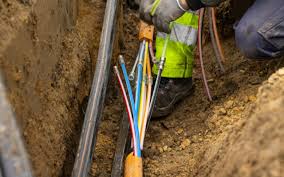
Nigeria’s rapidly expanding digital economy is facing a growing infrastructure threat as repeated damage to fibre-optic cables disrupts communications, banking transactions and other critical digital services.

The Nigerian Communications Commission (NCC) recorded 5,934 fibre-optic cable cuts in the first six months of 2025, equivalent to roughly 33 incidents every day, according to figures cited by the source. The industry had recorded 19,384 cuts between January and August of the previous year.
MTN Nigeria, the country’s largest telecommunications operator, separately reported 5,478 fibre cuts in the first seven months of 2025, with the number exceeding 9,000 for the full year.
The scale of the problem was highlighted by a recent fibre cut on the Backbone Connectivity Network (BCN) in Abuja Municipal Area Council, which affected data and internet services across parts of the Federal Capital Territory.
Subscribers, businesses, government offices and financial institutions experienced slow connections, intermittent service and outright outages. Online transactions were disrupted, Voice over Internet Protocol services failed, while cloud applications and other digital platforms became unreliable.
For businesses that depend on uninterrupted connectivity, the disruption translated into delayed service delivery and broken customer communication channels.
Industry stakeholders attribute the majority of fibre damage to road construction, excavation and other civil works, which they say account for 60 per cent or more of reported incidents.
Vandalism and theft account for much of the remaining damage, while poor coordination among contractors and utility operators increases the risk of cables being severed during excavation.
Major incidents have been reported across parts of the Southeast and Southsouth, as well as Lagos, Abuja, Rivers, Kano and Kaduna, areas that also carry significant volumes of business, banking and fintech traffic.
The consequences extend beyond the physical location of a damaged cable.
Fibre networks carry high-capacity traffic supporting mobile networks, fixed broadband services, data centres and international connectivity. When a major route is cut, operators must identify the fault, excavate the affected area, splice or replace the damaged fibre and test the network before restoring full service.
Depending on the location and extent of the damage, repairs can take hours or longer, while network redundancy may not prevent service degradation for large numbers of users.
The financial implications are also significant.
Industry estimates cited in the report put the combined annual cost of fibre damage, including repairs, lost revenue and operational disruption, at between ₦27 billion and ₦35 billion.
Telecom operators are therefore spending substantial amounts maintaining and relocating fibre infrastructure, diverting funds that could otherwise be deployed towards network expansion and capacity improvements.
MTN alone has allocated billions of naira to fibre maintenance and relocation.
The stakes are high because telecommunications has become a critical part of Nigeria’s wider economy.
The sector contributes about 9.7 per cent of real GDP and supports trillions of naira in digital transactions. A major fibre outage can therefore affect far more than telecommunications customers, disrupting payment terminals, banking applications, cloud services and other digital systems.
The effects can spill into commerce, logistics, healthcare, education and government services.
Small businesses can lose sales when electronic payments fail, while remote workers and students may lose access to essential online services. Healthcare and emergency services can also face communication challenges during major outages.