


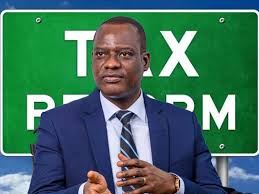
The Federal Government has announced plans to launch a Nigeria Deal Room, a strategic platform designed to transform investment opportunities into bankable projects and accelerate the flow of private capital into key sectors of the economy.

Mr. Taiwo Oyedele, Minister of Finance and Coordinating Minister of the Economy, unveiled the initiative on Monday at the opening of the Invest Lagos 3.0 Summit, describing it as a critical tool for bridging the gap between investment discussions and actual project execution.
According to Oyedele, the Nigeria Deal Room will identify investment-ready projects, facilitate regulatory approvals, remove bureaucratic bottlenecks and connect investors directly with viable opportunities across the country.
“Too often, brilliant opportunities are known but insufficiently prepared. Investors are interested but cannot navigate the entry points. Projects exist, but they are not bankable or investment-ready,” he said.
“To bridge this gap, the Federal Ministry of Finance is establishing a Nigeria Deal Room to move from conversation to actual transaction.”
He explained that the platform would serve as a one-stop investment facilitation hub, helping project promoters prepare viable proposals while ensuring investors have access to credible, well-structured opportunities.
The minister noted that global investors are increasingly seeking markets that are predictable, competitive and profitable, adding that the Federal Government has implemented a series of reforms aimed at strengthening Nigeria’s investment environment.
Highlighting recent economic reforms, Oyedele cited the unification of exchange rates, the adoption of a market-driven foreign exchange system and measures to strengthen the nation’s external reserves.
According to him, Nigeria’s net external reserves have grown from less than $4 billion in 2023 to more than $30 billion, while gross reserves are approaching the $50 billion mark.
He also pointed to encouraging economic indicators, revealing that Nigeria recorded real Gross Domestic Product (GDP) growth of 3.89 per cent in the first quarter of 2026 and achieved 11.2 per cent growth in U.S. dollar terms in 2025.
Oyedele expressed confidence that the country would sustain double-digit GDP growth in dollar terms this year, positioning Nigeria among the leading contributors to global economic expansion in 2026.
The minister stressed that the next phase of Nigeria’s economic growth would be driven largely by state governments leveraging national reforms to attract investments and create jobs.
“The future of Nigeria’s growth story is being written in Lagos, Kano, Enugu, Uyo, Abeokuta, Ilorin, Kaduna, Lafia, Owerri and Umuahia,” he said.
“While national reforms create the enabling environment, it is our subnational governments that convert potential into projects, investments, jobs and tangible economic outcomes.”
He cited Lagos as a model for investment attraction, pointing to the recent commissioning of the Kasi Hyperscale Data Centre, an investment supported by the Nigeria Sovereign Investment Authority (NSIA).
Oyedele also highlighted Lagos’ leadership in Africa’s technology ecosystem, noting that five of Nigeria’s tech unicorns are headquartered in the state.
“Africa is home to nine tech unicorns, and five of them are from Nigeria, all headquartered in Lagos,” he said.
On fiscal reforms, the minister said the government has simplified overlapping tax structures, improved Value Added Tax (VAT) administration by allowing full input credits on investments, introduced sector-specific incentives and established an Office of the Tax Ombud to address taxpayer grievances.
“Our goal is not to tax more. It is to tax smarter,” he stated.
According to him, the government aims to increase Nigeria’s tax-to-GDP ratio from about 10 per cent to at least 18 per cent within the next three years by expanding economic activity and encouraging greater business formalisation rather than imposing excessive tax burdens.

