


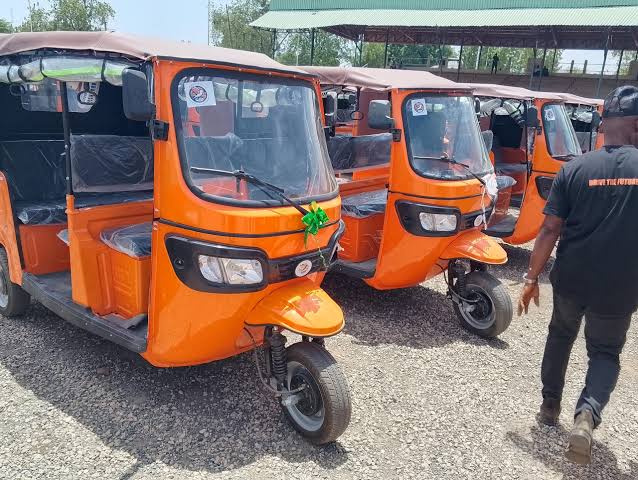
The Federal Government will deploy 10,000 electric tricycles across Nigeria in August as part of its drive to modernise public transportation, reduce mobility costs, and accelerate the country’s transition to cleaner energy solutions.

Vice President Kashim Shettima disclosed this on Monday while receiving members of Transporters for Tinubu/Shettima 2027 during a courtesy visit to the Presidential Villa, Abuja.
According to Shettima, the initiative will be implemented by the North East Development Commission (NEDC), with the electric tricycles initially distributed across the North-East and other parts of the country. He added that President Bola Tinubu has approved the replication of the programme through the various regional development commissions nationwide.
The Vice President said the electric mobility project forms part of the administration’s broader strategy to transform Nigeria’s transportation system into an integrated logistics network capable of supporting commerce, agriculture, industry, and national development.
In a statement issued by the Senior Special Assistant to the President on Media and Communications in the Office of the Vice President, Stanley Nkwocha, Shettima explained that the government is working to connect ports, rail lines, inland waterways, airports, CNG-powered trucks, and feeder roads into a seamless transport ecosystem.
“The priority of this administration is to move Nigeria from a fragmented transport system to an integrated logistics chain where ports, rail lines, CNG-powered trucks, inland waterways, airports and local feeder roads work together to support commerce, agriculture, industry and national integration,” he said.
Shettima noted that the administration’s transport reform agenda is anchored on the nationwide rollout of Compressed Natural Gas (CNG), extensive port modernisation, and investments in logistics infrastructure.
According to him, the reforms are designed to improve efficiency, lower transportation costs, and enhance working conditions for operators across the road, rail, maritime, aviation, and pipeline sectors.
He said the government’s vision is to create a transport economy that enables the seamless movement of goods and people while connecting farmers to markets and businesses to consumers.
“Our vision is an unbroken logistics chain, where a container moves from a deep-sea port to a rail wagon, then to a CNG-powered truck, and finally to a trader in Ariaria Market or Maiduguri without delay or policy failure,” the Vice President stated.
Highlighting progress under the Presidential Compressed Natural Gas Initiative, Shettima said the programme has demonstrated the economic potential of Nigeria’s vast gas resources.
“We said CNG could cut fuel costs by over 60 per cent, and many called it fantasy. Today, heavy-duty trucks run on Nigerian gas, proving sceptics wrong and returning money to your pockets,” he said.
