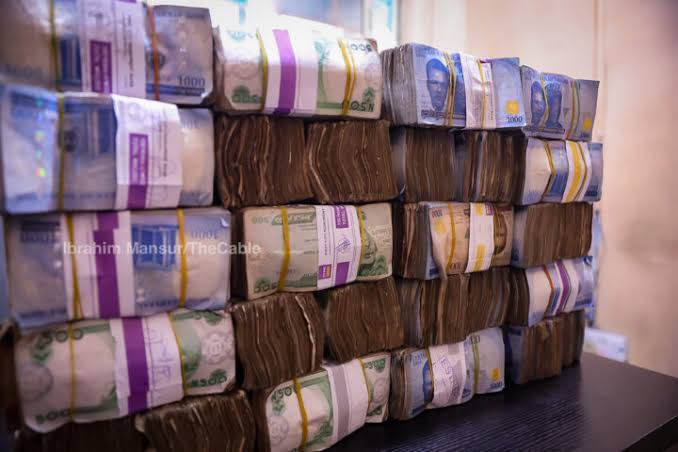
The Federal Government says it has disbursed more than N600 billion in cash transfers to vulnerable Nigerians over the past three years, reaching slightly more than 10 million households.

Bernard Doro, Minister of Humanitarian Affairs and Poverty Reduction, disclosed the figure on Wednesday during an interview on Channels Television’s Politics Today.
The disclosure comes as the Federal Government launches a new $1 billion social protection programme, the Household Prosperity and Empowerment Social Protection Project (HOPE-SP), under the broader Renewed Hope Social Protection Programme.
The initiative, unveiled by First Lady Oluremi Tinubu, is targeting about 7.6 million vulnerable households across the country. Each eligible household is expected to receive a one-off digital shock-response transfer of N40,000.
Doro said the government’s approach to poverty reduction was evolving from providing short-term financial relief to tracking whether beneficiaries were making progress towards economic self-reliance.
“We’ve done over N600 billion in cash transfers to be able to support vulnerable Nigerians within three years. We have reached slightly over 10 million households,” he said.
He added that the government now has systems designed to deliberately track poverty and measure the progress of households benefiting from social protection programmes.
The minister also defended the government’s economic reforms, including the removal of the petrol subsidy, arguing that the reforms were contributing to greater economic stability.
Doro rejected claims that seven million Nigerians had fallen into poverty under the current administration, saying the government was focused on reducing inflation and rebuilding the economy.
He compared Nigeria’s poverty reduction challenge with China’s experience, noting that large-scale poverty reduction takes time.
“It took China 40 years to achieve the scale they achieved. Nigeria can scale up poverty reduction,” he said.
Under HOPE-SP, beneficiaries must be listed on the National Social Register and validated using their National Identification Number (NIN).
The Federal Government is working with the National Identity Management Commission to facilitate NIN registration and strengthen the verification process for eligible households.
The new programme is part of broader efforts by the government to expand social protection and cushion vulnerable Nigerians from the impact of economic reforms.
In February, about N330 billion had reportedly been disbursed to 8.11 million households under the Conditional Cash Transfer scheme, while government data indicated that approximately 19.78 million households were classified as vulnerable on the National Social Register.
In July, the government also unveiled a $3.05 billion package of programmes aimed at reducing poverty, strengthening human capital and protecting vulnerable Nigerians from economic shocks.
The package included about $1.25 billion in additional financing for the Nigeria Community Action for Resilience and Economic Stimulus (NG-CARES) programme, targeting smallholder farmers, vulnerable households, small businesses and community livelihood initiatives.
The expansion of social intervention programmes has raised concerns over transparency, accountability and whether government funds ultimately reach their intended beneficiaries.
The Centre for the Promotion of Private Enterprise (CPPE) recently warned that corruption, political interference and weak implementation could undermine the impact of the government’s new social intervention programmes.
The group called for stronger safeguards to minimise leakages and ensure that assistance reaches eligible households.
The concerns are particularly significant as the Federal Government moves to expand cash transfers while attempting to transition beneficiaries from short-term relief towards longer-term economic empowerment.