
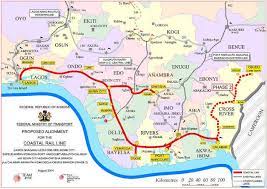
The Federal Government has said it may demolish buildings obstructing drainage alignments along the Lagos-Calabar Coastal Highway corridor as part of measures to improve flood control and construct service lanes.

David Umahi, Minister of Works, disclosed this after a joint inspection of the highway ordered by President Bola Tinubu in response to concerns over flooding in communities along the project corridor.
The inspection team included officials from the Federal Ministry of Environment, members of the National Assembly, project consultants, contractors and presidential aides.
Speaking to journalists after the tour, Umahi dismissed claims that the Lagos-Calabar Coastal Highway caused flooding in affected communities, insisting that engineering assessments showed the project’s drainage infrastructure was performing as designed.
Instead, he blamed the flooding on blocked drainage channels, indiscriminate waste disposal, illegal reclamation of natural waterways and poor urban planning.
“The coastal highway is even helping to convey floodwater from one point to another,” he said.
Umahi said the Federal Government would work with the Lagos State Government on a comprehensive flood management programme, including the construction of service lanes, expansion of drainage infrastructure and restoration of blocked natural water channels.
He acknowledged that implementing the plan could require the removal of structures obstructing drainage routes.
“Some buildings must have to go to solve this problem,” the minister said, adding that property owners affected by the exercise would be compensated where applicable in line with government procedures.
Addressing flooding at Alpha Beach, one of the worst-hit communities, Umahi maintained that the area had experienced flooding long before construction of the Lagos-Calabar Coastal Highway began.
He said many estates were built on low-lying terrain without adequate consideration for flood risks or environmental impact assessments.
The minister called for stricter enforcement of planning regulations to ensure future developments comply with environmental standards and are resilient to climate change and rising flood risks.
Umahi also described the coastal highway as a protective barrier against Atlantic Ocean surges through ongoing shoreline protection works designed to prevent the sea from advancing inland.
He urged residents to stop dumping refuse into drainage channels and vandalising highway infrastructure, warning that blocked culverts and damaged drainage systems significantly worsen flooding during heavy rainfall.
Supporting the minister’s position, Senior Special Assistant to the President on Community Engagement (South-West), Moremi Ojudu, said the Federal Government would intensify public awareness campaigns in flood-prone communities.
She said residents, Community Development Associations and Community Development Committees all have important roles to play in keeping drainage channels clear and promoting proper waste disposal.
“The coastal highway is not in any way causing the flooding issues in our homes,” Ojudu said.
She added that her office would collaborate with the Lagos State Ministry of Environment and community organisations to strengthen public awareness and improve waste management practices.
Officials of the Federal Ministry of Environment and members of the National Assembly also described flooding in Lagos as a complex challenge driven by climate change, rising tides, rapid urbanisation, blocked drainage systems and poor planning.
They maintained that the Environmental Impact Assessment for the coastal highway met statutory requirements and incorporated recommendations from stakeholders before construction commenced.
Meanwhile, Managing Director of Hitech Construction Company, Danny Abboud, pledged to immediately clear blocked culverts, remove refuse obstructing drainage channels and continue monitoring water flow along the corridor in collaboration with the Federal Ministry of Works.
The Federal Government said consultations with the Lagos State Government would continue as work progresses on drainage improvements, service lanes and other flood-control measures aimed at protecting communities along the Lagos-Calabar Coastal Highway.