


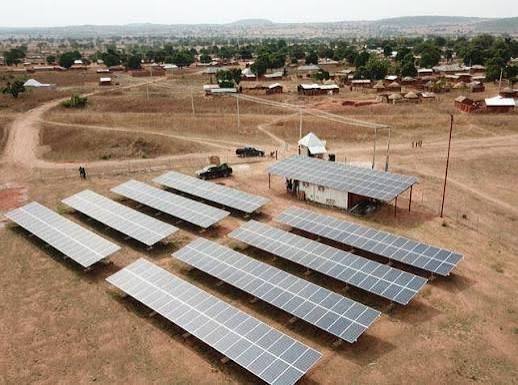
The Federal Government has launched 42 renewable energy projects in Adamawa and Kebbi states aimed at providing clean electricity to about 50,000 households, businesses and public institutions as part of efforts to expand energy access across underserved communities.

The projects, being implemented by the Rural Electrification Agency (REA), comprise 39 mini-grid projects in Adamawa State and a 3.5-megawatt solar power project alongside a 33kV power infrastructure project in Kebbi State under the Federal Government’s rural electrification programme.
In Adamawa, the government flagged off the construction of 39 mini-grids under the Distributed Access through Renewable Energy Scale-up (DARES) Programme.
The projects include three interconnected mini-grids in Kofare, Saminaka and Mbamba with installed capacities of 10 megawatts, 2.6 megawatts and 890 kilowatts respectively, as well as 36 isolated mini-grids that will serve remote communities.
Speaking at the groundbreaking ceremony, Joseph Tegbe, Minister of Power, described the initiative as a significant milestone in the Federal Government’s drive to achieve universal electricity access under President Bola Ahmed Tinubu’s Renewed Hope Agenda.
According to the minister, the projects will inject nearly 27 megawatts of clean and reliable electricity into communities across Adamawa, making it one of the largest decentralised renewable energy programmes implemented in a single state.
The projects are expected to provide electricity to about 40,000 households and businesses in communities including Kofare, Saminaka, Mbamba, Gulak, Michika, Shuwa, Bazza, Belel, Ganye, Song, Hong, Mubi and Guyuk.
Tegbe said the initiative will also support approximately 6,000 micro, small and medium-sized enterprises (MSMEs), including welders, tailors, grain millers, cold-room operators, ICT businesses and agro-processors, helping to boost productivity, create jobs and reduce reliance on petrol and diesel generators.
More than 100 public institutions, including schools, healthcare facilities and water projects, are also expected to benefit. “Behind every connection is more than a meter. It is a family whose quality of life will improve, a child whose education will be enhanced, an entrepreneur whose business will expand, and a community whose future will become brighter,” Tegbe said.
He noted that the mini-grids are designed to complement the national grid in communities with limited or no electricity while attracting greater private sector investment into Nigeria’s renewable energy sector.
Governor Ahmadu Fintiri described the project as a turning point in the state’s efforts to tackle energy poverty and accelerate economic development. “This is not just a foundation laying; it is the announcement of our collective resolve to launch a strategic onslaught against energy poverty and deliberately harness nature’s bounties through alternative energy sources,” he said.
Fintiri recalled that the initiative began in 2025 following an REA investment roundtable in Abuja, where the state offered incentives including land, concessional financing and credit guarantees to attract renewable energy developers.
He said the project, being implemented by Mahashakti Nigeria Limited in collaboration with the Yola Electricity Distribution Company (YEDC), would expand access to electricity and stimulate economic growth across the state.
Abba Abubakar Aliyu, Managing Director of the Rural Electrification Agency, said the projects reflect the agency’s commitment to ensuring no community is left behind in Nigeria’s energy transition.
He said the success of the initiative would ultimately be measured by the businesses created, jobs generated, improved healthcare and education services, mechanised farming and the overall impact on livelihoods rather than the megawatts deployed.
In Kebbi State, Governor Nasir Idris flagged off the construction of a 3.5-megawatt solar power plant and the Lot 7 Design, Supply and Installation of a 33kV power infrastructure project in Ambursa.
The project is expected to strengthen electricity supply in the state and complement the Federal Government’s broader strategy of expanding renewable energy infrastructure to improve access to reliable power and support economic development in underserved communities.

