
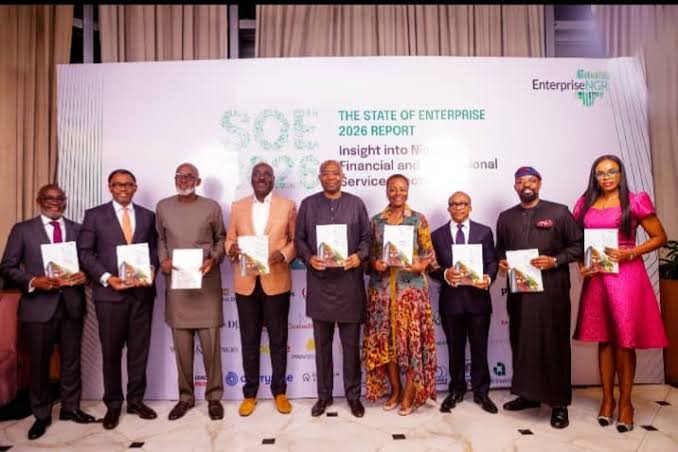
Nigeria’s Financial and Professional Services (FPS) sector is emerging as a major engine of economic growth, investment and government revenue despite persistent macroeconomic challenges, according to the State of Enterprise Report 2026 released by EnterpriseNGR.

The report, unveiled at the EnterpriseNGR Members’ Night in Lagos, provides a comprehensive assessment of the country’s banking, insurance, capital markets, pensions, fintech, professional services and sustainable finance sectors.
Speaking at the launch, Obi Ibekwe, EnterpriseNGR Chief Executive Officer, described the report as a practical guide for business leaders, investors and policymakers navigating Nigeria’s evolving economic landscape. “The State of Enterprise Report 2026 is not just a review of sector performance; it is a decision-making tool. It shows where confidence is returning, where capital is moving, where reforms are beginning to take effect and where further action is required to unlock the full potential of Nigeria’s Financial and Professional Services sector,” she said.
She noted that the report underscores the strategic importance of banking, capital markets, insurance, pensions, fintech and professional services in driving enterprise development, attracting investment and strengthening Nigeria’s competitiveness. “Across banking, capital markets, insurance, pensions, fintech and professional services, the data tells a clear story: the FPS sector is central to enterprise, investment and national competitiveness. The task ahead is to convert this momentum into deeper inclusion, stronger institutions, better regulation and sustained economic growth,” Ibekwe added.
According to the report, Nigeria’s financial services sector remained resilient despite inflationary pressures, high interest rates, exchange rate adjustments and ongoing structural reforms.
Deposit Money Banks recorded total assets of N180.37 trillion, equivalent to 41.8 per cent of Nigeria’s nominal Gross Domestic Product (GDP), reflecting the sector’s growing importance to the economy.
The report also showed that financial and insurance activities generated N1.50 trillion, accounting for 30 per cent of total Company Income Tax collections, while contributing an additional N421 billion in Value Added Tax (VAT) revenue.
The report highlighted robust performance across other segments of the financial sector.
Nigeria’s capital market posted significant gains, with the Nigerian Exchange All-Share Index advancing 51.19 per cent in 2025 before extending its rally in the first quarter of 2026.
Market capitalisation climbed 58.3 per cent to N99.38 trillion and further increased to N129.21 trillion by the first quarter of 2026. Total market transactions also more than doubled to N11.92 trillion.
In the insurance industry, Gross Premiums Written rose 47.3 per cent to N2.30 trillion, while total industry assets increased 24.2 per cent to N4.79 trillion.
The pension sector also maintained strong momentum, with assets growing 21.9 per cent to N27.45 trillion before reaching N29.52 trillion in the first quarter of 2026.
The report reaffirmed Nigeria’s position as Africa’s leading fintech market, with more than 500 fintech companies collectively valued at over $10.6 billion.
Electronic payment transactions reached N384 trillion across 4.12 billion transactions by July 2025, underscoring the rapid adoption of digital financial services across the country.