


By Ishola N. Ayodele, fimc-CMC

“It is not what you say but what the audience hear that matter” Ishola Ayodele
In politically charged environments, audiences often hear what they want to hear rather than what is actually said. This phenomenon underscores my fundamental principle of strategic communication: the onus of understanding in communication does not rest on the audience, it is on the speaker. As Nigeria’s First Lady, Senator Oluremi Tinubu, recently discovered, even well-intentioned remarks can ignite widespread backlash when stripped of context and amplified through digital echo chambers.
The Background
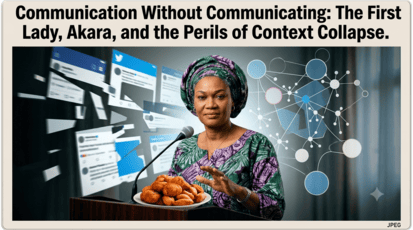
On June 26, 2026, Nigeria’s First Lady addressed journalists following a Renewed Hope Initiative (RHI) meeting with governors’ wives. Her remarks intended to explain the philosophy behind providing grants for micro-enterprises sparked viral outrage, mockery by skit makers, and accusations of trivialising economic hardship. The statement that ignited the firestorm was deceptively simple:
“We’re trying to give hope. To start akara business doesn’t take a lot of money. To start roasting corn and kuli-kuli doesn’t take much. We didn’t give them a loan; we gave it to them as a grant.”
Within hours, social media platforms were flooded with memes, parodies, and condemnations. The narrative that crystallised was that the First Lady had advised struggling Nigerians to “go and sell akara” as a solution to multidimensional poverty. But was that what she actually said? And more importantly, why did so many Nigerians hear something different from what she intended?
This is another classic example of what I term “communication without communicating,” where the speaker believes she is communicating, but communication, in the truest sense, is not actually taking place.
What Was Actually Said
Fuller reports from outlets including Pulse Nigeria, Punch Newspapers, The Cable, and BBC Pidgin reveal a more nuanced picture than the viral clips suggested. Speaking after an RHI meeting, the First Lady was defending the philosophy behind providing grants (not loans) to empower beneficiaries in micro-enterprises, alongside broader interventions in health, agriculture, education, and ICT.
Key contextual elements that were largely lost in the viral dissemination include:
- The grant mechanism: She explicitly distinguished grants from loans, emphasising that beneficiaries were not being burdened with repayment obligations.
- The broader portfolio: Her remarks referenced significant health interventions, including ₦2 billion for tuberculosis, ₦1 billion for breast cancer interventions, and ₦500 million to combat malnutrition. The RHI has also provided scholarships and ICT training in collaboration with NITDA.
- The audience: She was speaking to journalists after a coordination meeting with governors’ wives, not delivering a national address to the general public.
However, the viral clip isolated the everyday examples of akara, roasted corn, and kuli-kuli, framing them as the government’s primary response to economic hardship. The short-form video on social platforms became the message, and nuance became the first casualty.
The Public Reaction: A House Divided
The First Lady’s comments have sparked a significant debate, reflecting Nigeria’s polarised public discourse.
Critics: A Symbol of Disconnection
Many Nigerians, particularly on social media, argued that the advice trivialises the depth of economic hardship. With inflation at record highs and unemployment rates climbing, even “small” businesses require significant capital. One user stated the advice shows “exactly how disconnected Nigeria’s ruling class has become from the reality of ordinary citizens.” Skit makers quickly produced parodies, and the akara reference became shorthand for elite condescension.
Supporters: Dignity in Labour
Others defended the remarks, arguing that akara is a lucrative business that has helped countless families build homes and educate children. A supporter argued: “There’s dignity in labour… these are our local snacks! People should start it and scale it!” For this constituency, the backlash represented a misunderstanding of entrepreneurial reality.
The Underlying Truth
Both perspectives contain elements of truth. The First Lady was not wrong that micro-enterprises like akara vending can be pathways out of poverty. Nor were Nigerians wrong to feel that such advice, in isolation, seemed to ignore the structural barriers to economic mobility. The tragedy was not in what was said, but in how it was heard.
Understanding the Communication Breakdown
This episode exemplifies the perils of context collapse and framing effects in modern political communication, and offers critical lessons for leaders and their communications advisers.
Context Collapse
As conceptualised by Danah Boyd and Alice Marwick, context collapse occurs when diverse audiences, once segregated by physical or social boundaries flatten into a single digital space, leading to misinterpretations as messages intended for one group reach unintended recipients with different expectations and norms (Marwick & boyd, 2011).
In Nigeria’s charged socio-political climate, a casual explanatory remark to journalists became a national symbol of elite disconnect. The First Lady’s words, intended for journalists who understood the context of her broader empowerment agenda, were instantly transported to millions of Nigerians experiencing the harsh realities of inflation, unemployment, and multidimensional poverty. The audience for whom the message was intended was not the audience that ultimately received it.
Framing Effects
According to Entman (1993), framing involves selecting and highlighting certain aspects of reality to promote a particular interpretation. Media and social platforms emphasised the vivid, relatable images of street-level vending over the grant mechanism and broader sectoral support. This selective emphasis activated pre-existing frames of governmental insensitivity amid economic strain.
In such an environment, the akara reference resonated not as pragmatic micro-empowerment but as tone-deaf minimisation. The frame that dominated was not “empowerment through grants” but “elite tells poor to sell snacks.”
Lessons for Communicators
1. Words Matter
It is often said, “Sticks and stones may break my bones, but words will never hurt me.” In reality, the opposite is often true: broken bones heal, but words can shape perceptions that endure for years. Words evoke meaning, and meaning drives perception. For this reason, leaders especially political leaders must be deliberate in their choice of words.
In this case, the First Lady’s examples inadvertently created the conditions for misinterpretation. The backlash was not caused by the mention of akara, roasted corn, or kuli-kuli in isolation. Rather, those examples became the trigger for a pre-existing perceptual belief held by many Nigerians that political office holders are increasingly disconnected from the realities of ordinary citizens.
Perception does not develop overnight; it accumulates over time. The interpretive lens through which this statement was received had arguably been shaped by earlier public remarks, including the First Lady’s appeal for governors to provide official vehicles for women leaders and her offer to support the purchase of vehicles for women leaders in opposition-controlled states. Whether intended or not, those earlier communications had already contributed to a perception among many Nigerians of elite detachment.
As cognitive psychologist Raymond Nickerson (1998) explains, confirmation bias leads people to interpret new information in ways that reinforce their existing beliefs. Consequently, when the First Lady spoke about grants for micro-enterprises, many Nigerians did not hear a message of economic empowerment. Instead, they interpreted it through an existing perceptual frame: official vehicles for political elites, but akara, roasted corn, and kuli-kuli for ordinary citizens. What many people ultimately heard was not what she actually said, but what their existing perceptions predisposed them to hear.
2. Know Your Audience
From a public relations perspective, this episode reinforces a fundamental principle: communicators must anticipate not only what they intend to say but also how diverse audiences are likely to interpret it. Marshall McLuhan’s famous assertion in Understanding Media (1964) that “the medium is the message” is even more relevant in the age of short-form digital content. Today, the medium is often a 30-second viral clip stripped of its original context.
The First Lady appeared to speak primarily to the journalists before her, overlooking the fact that the ultimate audience would be millions of Nigerians encountering only a short excerpt on social media. Many of those viewers neither witnessed the full briefing nor understood the broader context of the Renewed Hope Initiative’s grant programme.
In today’s communication environment, speakers and their communication advisers must carefully consider who the real audience is, what pre-existing beliefs they hold, and what emotional state they are in. Messages should therefore be framed with those realities in mind. Addressing a nation grappling with severe economic hardship required not only explaining policy but also acknowledging public emotions. In moments of widespread hardship, emotional resonance often determines whether substantive policy explanations are accepted or rejected. Failure to recognise this can transform a routine policy update into what many perceive as an insensitive or dismissive remark.
3. Craft Messages with Precision
As a student of the Socio-Cultural School of Communication, I view communication as far more than the transmission of information. As I often say, “Communication is not talking or eloquence; it is the sharing of meaning through mind connection.” Effective communication occurs only when the meaning intended by the speaker closely aligns with the meaning constructed by the audience.
This understanding finds support in James Carey’s cultural approach to communication. In Communication as Culture (1989), Carey argues that communication is not merely the transmission of messages but a ritual through which societies construct shared beliefs, meanings, and identities. When public leaders speak, they are not simply providing information; they are participating in the construction of national narratives.
For this reason, public communication cannot be left to spontaneity or conversational ease. Messages intended for a national audience must be intentionally crafted, carefully framed, and tested against the realities, emotions, and expectations of those who will receive them. The First Lady’s conversational tone may have been entirely appropriate within the immediate setting, but once extracted from its context and consumed by millions online, it invited interpretations far removed from her original intent.
The lesson is clear: in an era of viral soundbites and context collapse, precision is no longer a luxury, it is a strategic necessity. Leaders must not only have the right intentions; they must ensure that their words are capable of producing the intended meaning across increasingly fragmented and emotionally charged audiences.
Conclusion
Leaders in polarised settings must adopt audience-centric strategic communication anchored on message discipline, full-context framing, and continuous testing for potential misinterpretations. As Plato noted, “A wise man speaks because he has something to say; a fool speaks because he has to say something.” The difference lies in foresight, empathy, and an awareness of how words travel beyond intention.
By internalising these principles and relying on seasoned communication advisers not as afterthoughts but as strategic partners leaders can turn communication risks into moments of trust-building and national connection. In an age of perpetual context collapse, strategic communication is no longer optional; it is the foundation of legitimacy, credibility, and leadership itself.
Ishola, N. Ayodele is a distinguished and multiple award-winning strategic communication expert who specialises in ‘Message Engineering’. He helps organisations, brands, and Leaders Communicate in a way that yields the desired outcome. He is the author of the seminal work, ‘PR Case Studies; Mastering the Trade,’ and Dean, the School of Impactful Communication (TSIC). He can be reached via ishopr2015@gmail.com or 08077932282.

