
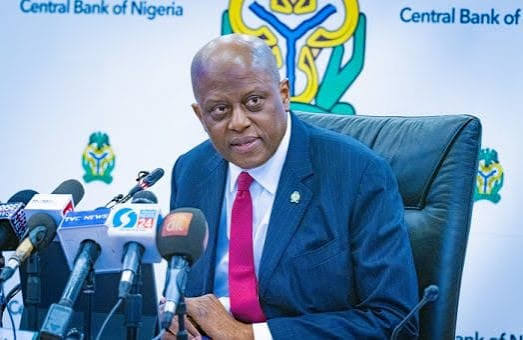
The Central Bank of Nigeria (CBN) has retained its benchmark interest rate at 23 per cent, opting to maintain a tight monetary policy stance despite five consecutive months of declining inflation. The decision followed the 308th meeting of the Monetary Policy Committee (MPC), held between Monday and Tuesday, as the apex bank sought to consolidate recent gains in price stability while guarding against fresh inflationary pressures.

Olayemi Cardoso, CBN Governor, announced the decision, reaffirming the bank’s ambition to bring inflation down to single digits. “Our goal is single-digit inflation, and we will not stop until we get there,” Cardoso said.
The committee also retained the standing facilities corridor at +50 and -300 basis points around the MPR, while keeping the Cash Reserve Requirement (CRR) at 45 per cent for deposit money banks, 16 per cent for merchant banks and 75 per cent for non-Treasury Single Account public sector deposits.
According to the MPC, although the sustained moderation in inflation was encouraging, prevailing domestic and international economic conditions required caution to prevent a reversal of recent progress.
Nigeria’s headline inflation declined to 14.06 per cent in October 2026 from 14.63 per cent in September, representing a 0.57 percentage-point reduction.
The MPC attributed the improvement to declining food and core inflation, supported by tight monetary conditions and relative stability in the foreign exchange market. Core inflation fell significantly from 12.95 per cent to 10.78 per cent, driven largely by lower price pressures in housing, education, insurance and financial services.
Food inflation also moderated to 19.13 per cent from 19.59 per cent, reflecting improved supplies of processed food and agricultural produce as the harvest season commenced.
Despite the improvement, the committee warned that increased festive spending, election-related expenditure and the ongoing Middle East conflict could trigger fresh price pressures. The CBN said it would continue monitoring economic developments before making further monetary policy adjustments.
Cardoso said adjustments made at the previous MPC meeting were beginning to produce the intended effects, with financial market interest rates responding to changes in the policy environment. He noted that interbank rates had moved closer to the lower boundary of the standing facilities corridor, while rates on Open Market Operations and Treasury bills had also moderated.
According to him, the narrowing gap between the policy rate and prevailing market interest rates indicates that monetary policy transmission is improving. Credit to the private sector has also begun to increase gradually, although the governor acknowledged that high borrowing costs remain a major concern for businesses.
“We are also quite mindful of the cost of credit, and we do believe that that is an aspect that we will continue to look at,” he said. He expressed optimism that improving market conditions would eventually translate into lower borrowing costs and better access to financing.
However, he clarified that the previous adjustment should not be interpreted as a shift towards monetary easing but rather an effort to align the policy rate more closely with market realities while maintaining a restrictive stance.
On the foreign exchange market, Cardoso expressed confidence that exchange rate volatility would moderate significantly in 2027, dismissing concerns over recent movements in external reserves and pressure on the naira.
He put Nigeria’s foreign reserves at approximately $54 billion to $55 billion, providing about 10 months of import cover.