


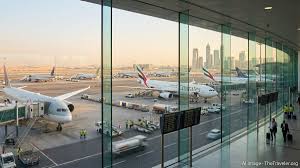
Airlines across Asia and Europe have suspended flights and cancelled services after escalating military strikes between the United States, Israel and Iran triggered sweeping airspace closures across the Middle East.

A Reuters report on Saturday showed flight-tracking maps with virtually empty skies over Iran, Iraq, Kuwait, Israel and Bahrain, as carriers halted operations or rerouted aircraft to avoid affected corridors.
The disruption follows coordinated strikes on Iran by the United States and Israel, and Iran’s subsequent missile retaliation, prompting several countries to shut or restrict their airspace amid heightened security risks.
Airports in key Gulf transit hubs were among the hardest hit.
Operations were suspended at Dubai International Airport and Al Maktoum International Airport, with passengers advised not to travel until further notice.
Leading regional carriers, including Emirates and flydubai, temporarily halted services to and from Dubai.
Flight operations to and from Tel Aviv were also suspended as Israeli airspace restrictions took effect.
Preliminary data from aviation analytics firm Cirium showed a sharp rise in cancellations:
- Nearly 40 per cent of flights to Israel were cancelled.
- About 6.7 per cent of flights across the wider Middle East were scrapped.
Major European airlines, including British Airways, Lufthansa, Air France, Iberia and Wizz Air, suspended or cancelled flights to Tel Aviv, Dubai, Abu Dhabi, Amman and Bahrain.
Regional carriers such as Qatar Airways, Kuwait Airways and Turkish Airlines also paused select routes.
The European Union Aviation Safety Agency (EASA) advised airlines to avoid the affected airspace until further notice, further complicating route planning.
The Middle East is one of the world’s most critical aviation corridors, linking Europe and Asia through hubs such as Dubai, Doha and Abu Dhabi.
With airspace over Iran, Iraq, Israel and neighbouring states either closed or heavily restricted, airlines have been forced to reroute aircraft over longer paths. This increases fuel costs, extends flight times and disrupts tightly coordinated global schedules.
Thousands of passengers were stranded across major transit hubs as airlines scrambled to reorganise operations.
Nigeria’s Federal Government has issued a security advisory to Nigerians living in Iran and neighbouring Gulf countries, urging them to remain alert and prioritise personal safety.
The government said it is closely monitoring developments following the reported strikes and retaliatory missile attacks, as tensions threaten to further destabilise one of the busiest regions in global aviation.
Analysts warn that if airspace restrictions persist, the ripple effects could spread beyond the Middle East, impacting intercontinental routes, ticket prices and global travel supply chains.

