


By Elvis Eromosele

Stories inform. They also shape perception. For decades, Africa’s economic story has largely been told through the language of what is missing: electricity, infrastructure, jobs, industrial capacity and access to capital.
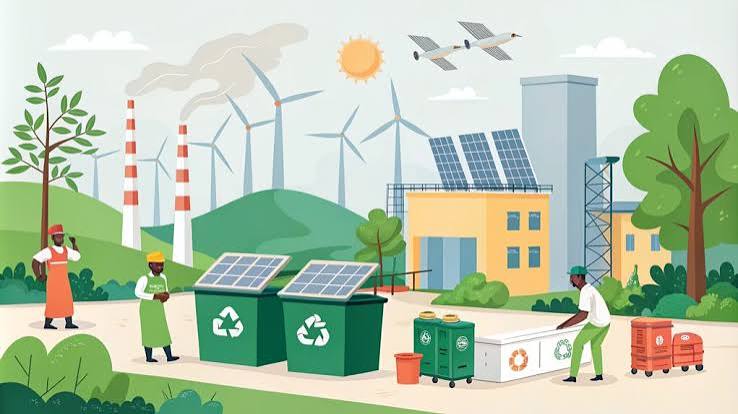
But another story is emerging. Across the continent, solar projects are expanding access to energy, recycling businesses are turning waste into livelihoods, young innovators are developing climate solutions, and industries are beginning to rethink how they produce, consume and grow.
The shift is subtle in some places and dramatic in others, but the direction is increasingly clear. Africa is beginning to ask a more important question than whether it can grow. How can the continent grow differently, and ensure that growth creates value for more people?
The question is urgent, especially as the global economy moves towards cleaner energy, more efficient production and more responsible use of natural resources.
Africa enters this transition with considerable advantages. The continent has abundant sunshine, significant wind, hydro and geothermal resources, vast agricultural potential, a young population and some of the critical minerals required for the emerging clean-energy economy.
The opportunity is enormous. But capturing it will require moving beyond the traditional model of exporting raw materials while importing finished products.
Thankfully, some countries are increasingly exploring ways to process minerals closer to where they are produced. This is creating opportunities for manufacturing, technical skills, supporting businesses and better-paying jobs. The same principle applies beyond mining.
Solar equipment can be assembled locally. Battery components can form new industrial value chains. Electric mobility can create opportunities in vehicle assembly, maintenance and charging infrastructure. Agricultural products can be processed closer to the farm, creating more value before reaching domestic or international markets.
The green economy, in this sense, is not simply about reducing carbon emissions. It is about building industries.
Now, no serious industrial transformation can happen without reliable energy. Yet millions of Africans still lack dependable electricity. This is despite the fact that the continent possesses some of the world’s strongest renewable-energy potential.
This contradiction presents one of Africa’s greatest sustainability challenges, and one of its biggest economic opportunities. Solar mini-grids can power rural businesses. Distributed energy can support small manufacturers.
Clean cooking can improve household health while creating new markets. Energy-efficient buildings can reduce operating costs, while electric mobility could gradually transform transportation in rapidly growing cities.
The energy transition should therefore not be viewed simply as a climate obligation. For Africa, it can be infrastructure for development.
The same opportunity exists in something as ordinary as waste. Across African cities, plastic, discarded electronics, used tyres, food waste and other materials are often treated as problems to be collected and disposed of. A circular economy changes the question.
Instead of asking, How do we get rid of this?, it asks, How do we keep this material useful?
This sort of shift can create businesses around recycling, repair, remanufacturing, sustainable packaging, composting and waste-to-value enterprises.
Today, informal recyclers already recover valuable materials from urban waste streams. The next step is to create systems that make this work safer, more productive and more economically rewarding.
The idea of a just transition becomes real here. A green economy cannot be considered successful simply because it produces better environmental statistics.
The harder question is: Where are the jobs?
Africa’s transition could generate employment across renewable energy, clean cooking, sustainable agriculture, waste management, electric mobility, green construction and other emerging industries.
But green jobs do not appear merely because an activity is labelled sustainable. They require skills, finance, infrastructure, supportive policies and businesses capable of turning ideas into viable enterprises.
Young Africans and women will be central to this transformation. They can become entrepreneurs, engineers, technicians, farmers, recyclers, researchers and digital innovators, provided the systems around them create room for participation and ownership.
The real challenge is to build a bridge between sustainability ambition and commercial reality. And the continent’s greatest advantage is that it does not necessarily have to repeat the development path followed by wealthier economies, industrialise first and attempt to clean up the consequences later.
Africa has already demonstrated its ability to leapfrog. Mobile technology transformed communication and financial services across markets without requiring the continent to reproduce every stage of traditional infrastructure development.
To my mind, the energy transition, digital sustainability and circular economy could offer similar opportunities.
This is precisely the thinking behind the Africa Sustainability Forum 2026, scheduled to take place in Lagos on October 20 under the theme, “Sustainable Futures: Driving Just Transitions, Green Growth & Shared Prosperity.”
The significance of the conversation extends beyond sustainability itself. It is about the kind of economic future Africa chooses to build. A future where resources create industries, where innovation creates jobs, where finance reaches opportunity, and where economic growth does not come at the expense of the people and environments that must sustain it.
Africa’s next growth story may well be green. The real opportunity is to ensure that it is also inclusive, commercially viable and shared.
Eromosele, a corporate communications expert, sustainability advocate, and Lead Coordinator for the Africa Sustainability Forum 2026, writes via elviseroms@gmail.com

