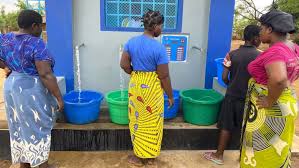
Africa faces a staggering annual financing gap of more than $30 billion in its quest to provide universal access to clean water and sanitation, raising concerns over the continent’s economic growth, public health, and climate resilience.

New data from the United Nations, African Union, World Bank, and the United Nations Economic Commission for Africa indicate that Africa requires between $45 billion and $50 billion annually to meet the clean water and sanitation targets outlined in the Sustainable Development Goals (SDGs).
However, current annual investments range between $10 billion and $19 billion, leaving a significant funding shortfall that continues to slow progress across the continent.
The scale of the challenge remains alarming.
According to the report:
- More than 400 million Africans lack access to safe drinking water.
- Over 700 million people do not have access to safely managed sanitation services.
- Only 81 per cent of Africans had access to safe drinking water in 2023.
- Sanitation coverage stood at just 59 per cent across the continent.
These gaps continue to undermine public health outcomes, economic productivity, food security, and environmental sustainability.
Speaking at the 2026 Annual Meetings of the African Development Bank Group, Claver Gatete warned that Africa’s water challenge has evolved beyond a social issue and now poses a major economic risk. “Underinvestment in water is not only a social concern but a structural economic constraint,” Gatete said.
He noted that water-related projects receive less than three per cent of global climate finance despite increasing droughts, floods, and water insecurity linked to climate change.
According to him, the mismatch between growing climate risks and limited investment is widening Africa’s development challenges.
Gatete called for a fundamental shift in how governments and investors view water infrastructure.
Rather than treating water solely as a public utility, he argued that it should be recognised as a strategic economic asset capable of driving industrialisation, agricultural productivity, energy generation, public health, and regional integration. “Water should not be seen only as a utility to be delivered, but as the bloodstream of our economies,” he said.
He added that water is central to unlocking Africa’s blue economy potential and should be treated as an investable sector capable of generating jobs, growth, and resilience.
To bridge the funding gap, the African Union and development partners have launched several initiatives.
At the COP28 climate summit, the African Union unveiled the Africa Water Investment Action Plan, aimed at accelerating financing for water security and sanitation infrastructure.
Meanwhile, the African Water Facility is targeting an additional $7 billion in investments through 50 urban sanitation projects across the continent.
Despite these efforts, implementation challenges and inconsistent public financing continue to hinder progress.
In Nigeria, federal allocations to water infrastructure have fluctuated sharply.
Funding for the Ministry of Water Resources and Sanitation increased to ₦296.64 billion in 2024, equivalent to about $395 million, before falling by nearly 50 per cent to ₦146.78 billion in the 2025 budget.
The Federal Government continues to implement major programmes, including:
- Sustainable Urban and Rural Water Supply, Sanitation and Hygiene (SURWASH)
- Partnership for Expanded Water Supply, Sanitation and Hygiene (PEWASH)
These initiatives currently cover 17 states and the Federal Capital Territory.
However, execution remains a major concern.
The World Bank’s $700 million SURWASH programme, designed to provide water access to six million Nigerians and sanitation services to 1.4 million people between 2022 and 2027, had disbursed only $93.59 million by May 2025, about 14 per cent of total funding commitments.
The World Bank reportedly rated implementation progress as “moderately unsatisfactory,” noting that only 58,585 beneficiaries had been reached against a target of more than six million people.
Despite these challenges, the Federal Government says more than 6,700 water schemes have been constructed in rural and urban communities under the current administration.