


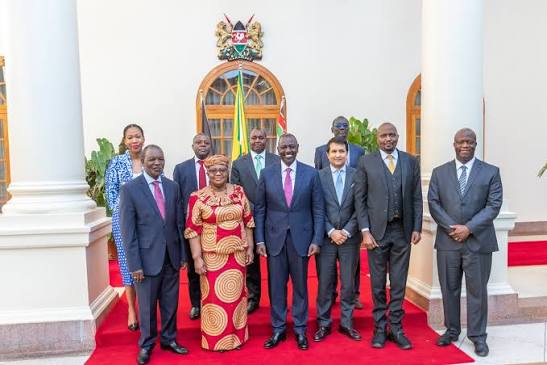
Africa has reached a pivotal moment in its economic history and must move from being a passive participant in global affairs to becoming an active driver of growth, innovation and trade, according to policymakers and economists at the 7th Africa Emerging Markets Forum in Abuja.

Speaking at the forum, held at the headquarters of the Central Bank of Nigeria (CBN), leading voices including WTO Director-General Ngozi Okonjo-Iweala, CBN Governor Olayemi Cardoso, and the Minister of Finance and Coordinating Minister of the Economy, Wale Edun, outlined strategies for positioning Nigeria and the wider continent to benefit from shifts in the global economy.
Despite approaching the issue from different perspectives, the speakers shared a common message: Africa must stop reacting to global economic changes and begin shaping its own future.
For decades, African economies have largely been at the mercy of external events, including commodity price swings, financial crises, pandemics, and geopolitical conflicts.
However, speakers argued that the changing global landscape, driven by evolving trade alliances, technological advances and shifting investment patterns, presents the continent with an opportunity to rewrite its economic story.
Opening the discussions, Cardoso described the current period as one of the most significant transformations in the global economy in decades. “The question is no longer whether the global order is changing, but how we turn that change from a source of vulnerability into a source of growth and shared prosperity,” he said.
According to the CBN governor, three major developments will determine Africa’s economic trajectory in the coming years.
The first is the reconfiguration of global trade. As countries increasingly reorganise supply chains around trusted partners and regional markets, Africa has an opportunity to strengthen local manufacturing, expand intra-African trade and reduce dependence on imports.
Cardoso said the African Continental Free Trade Area (AfCFTA) offers a framework for achieving this but stressed that regional integration must move beyond political agreements.
He called for improved transport infrastructure, harmonised customs procedures and efficient cross-border payment systems to make trade easier and cheaper across the continent.
The second trend is the changing behaviour of global investors.
Rather than chasing high returns alone, investors now prioritise policy consistency, transparency, institutional strength and economic credibility.
Cardoso said African governments must therefore focus on building stable economies while mobilising domestic sources of capital, including pension funds, insurance assets and diaspora investments. “Credibility is no longer only a central bank concern. It is a national economic asset,” he said.
The third transformation is the rapid rise of artificial intelligence (AI).
Describing AI as a game-changing technology, Cardoso said Africa must become a creator, not merely a consumer, of digital innovation.
That ambition, he noted, will require major investments in electricity, broadband infrastructure, digital connectivity and education to equip young Africans with future-ready skills. “Africa must move beyond being consumers of technology. We must become creators,” he said.
Despite the opportunities, Cardoso warned that sustained economic growth cannot be achieved without macroeconomic stability.
He argued that no country has successfully industrialised while grappling with high inflation, exchange rate instability and weak institutions.
Drawing on Nigeria’s recent reforms, he highlighted measures implemented by the CBN, including foreign exchange market reforms, the end of monetary financing of fiscal deficits and efforts to improve transparency in the FX market.
Although the reforms have required difficult adjustments, he said they were essential to restoring investor confidence. “Credibility is built intentionally, one right decision after another, and strengthened through consistent action,” Cardoso said.
He identified four priorities for Africa’s transformation: maintaining macroeconomic stability, deepening regional integration under AfCFTA, mobilising domestic capital and investing in human capital, particularly women and young people.
Addressing the growing migration of skilled professionals, often referred to as the “Japa” phenomenon, Cardoso urged African governments to create opportunities that encourage young talent to build successful careers at home.
“Africa cannot fly with one wing,” he said, underscoring the need to unlock the economic potential of women while empowering young entrepreneurs.
Okonjo-Iweala: Every crisis creates opportunity
Echoing many of Cardoso’s views, WTO Director-General Ngozi Okonjo-Iweala said Africa should see global disruptions as opportunities rather than setbacks.
She noted that multinational companies are increasingly diversifying their supply chains following lessons from the COVID-19 pandemic, geopolitical tensions and shipping disruptions.
According to her, Africa is well positioned to benefit from this shift if it acts decisively.
“We should always ask ourselves what opportunities exist within every crisis,” she said.
Okonjo-Iweala pointed out that Africa possesses abundant critical minerals needed for renewable energy technologies, electric vehicles and other industries of the future.
However, she warned that exporting raw materials alone would do little to transform African economies.
Instead, she urged governments to invest in value addition, industrialisation and manufacturing so that the continent captures more of the economic benefits from its natural resources.
A defining moment
The consensus emerging from the forum was that Africa stands at a defining crossroads.
As global trade patterns shift and technology reshapes industries, the continent has an unprecedented opportunity to accelerate industrialisation, deepen regional integration and become a stronger player in the global economy.
Realising that ambition, participants agreed, will depend on bold reforms, stronger institutions, sustained investment in people and infrastructure, and a commitment to transforming Africa from a supplier of raw materials into a hub for innovation, manufacturing and value creation.

