


For every democracy, political parties are the vehicles through which citizens express their aspirations and choose leaders. Consequently, the process of registering political parties should inspire confidence, certainty and fairness. When that process becomes entangled in prolonged litigation, conflicting court orders and procedural disputes, it raises fundamental questions about the strength of democratic institutions.

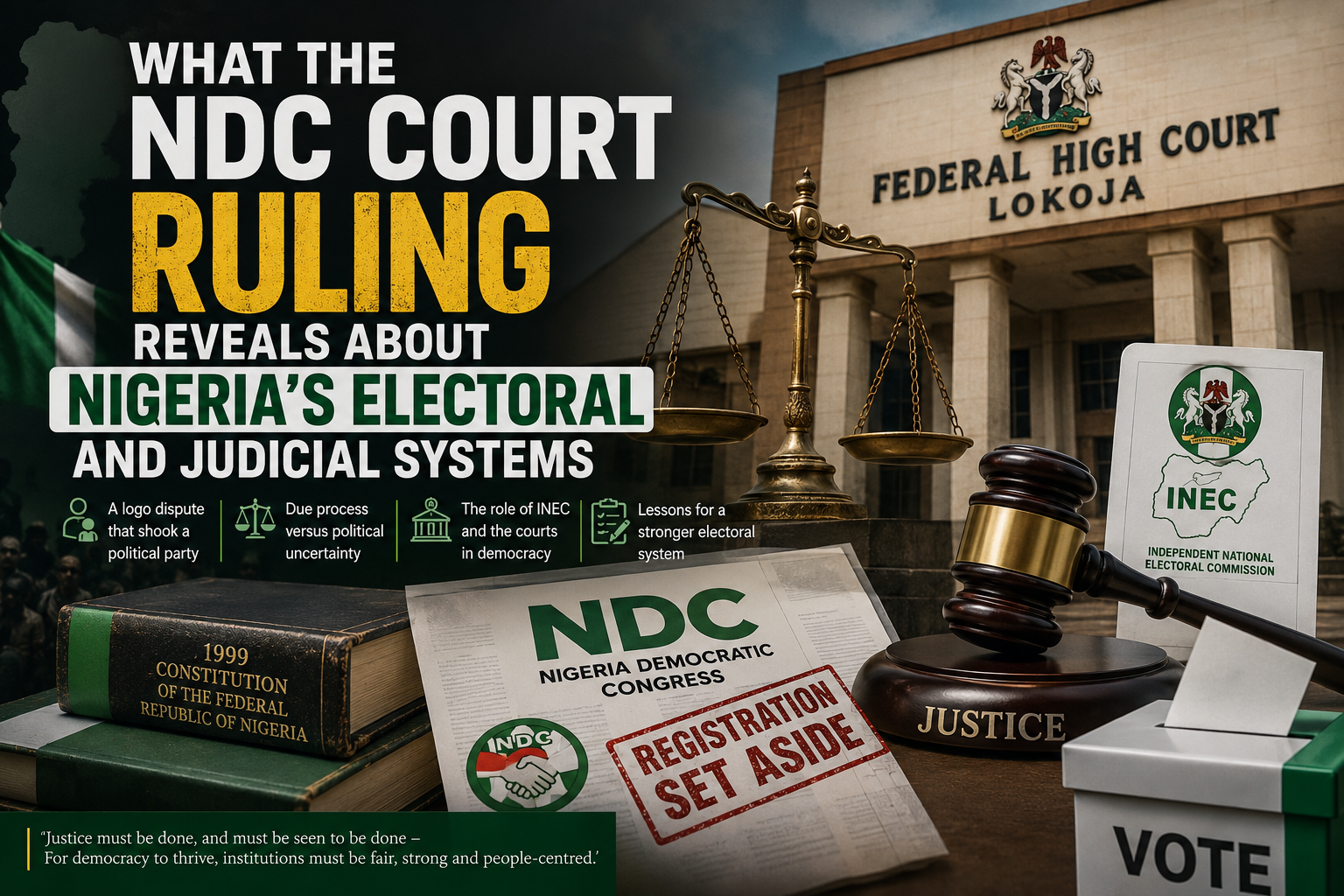
The recent decision of the Federal High Court in Lokoja to set aside its earlier judgment directing the Independent National Electoral Commission (INEC) to register the Nigeria Democratic Congress (NDC) is one such moment. Although the dispute centres on the ownership of the party’s logo, its implications extend far beyond intellectual property. It touches the integrity of electoral administration, judicial consistency, political competition and public confidence in Nigeria’s democratic process.
The ruling has effectively nullified, at least temporarily, the registration of the NDC pending a fresh hearing involving all interested parties. While lawyers may describe it as a procedural correction, politically it has reopened debate about how political parties emerge, how courts shape electoral outcomes and how institutions can avoid unnecessary uncertainty.
The principle behind Justice Isah Dashen’s ruling is difficult to fault from a legal standpoint. Every person or organisation whose interests may be affected by a court judgment deserves an opportunity to be heard.
The Peace Movement Party (PMP) argued that it owned the logo relied upon in obtaining the original judgment compelling INEC to register the NDC. Since the PMP was not joined in the original proceedings, the court agreed that its interests may have been adversely affected and consequently vacated its earlier judgment.
This reflects one of the oldest principles of justice: audi alteram partem – hear the other side.
In many respects, the ruling strengthens confidence in judicial fairness. Courts exist not merely to deliver speedy judgments but to ensure that every affected party receives a fair hearing.
However, while due process has been protected, institutional efficiency has suffered.
One troubling question remains unanswered.
How did a politically significant matter involving the registration of a national political party proceed to judgment without identifying every stakeholder whose rights could be affected?
Political party registration involves constitutional rights, electoral administration, party identity, trademarks and public interest. Such matters demand exceptional diligence.
If ownership of the logo was already disputed, why was the issue not resolved before judgment?
If the logo belonged to another political organisation, why was that organisation not joined from the beginning?
These questions expose weaknesses in legal preparation and procedural management that should concern every Nigerian, regardless of political affiliation.
Avoidable litigation creates uncertainty that ultimately weakens democratic institutions.
The immediate casualty is the NDC.
The party now faces legal uncertainty regarding its registration, public identity and participation in future electoral activities.
Any organisational expansion, membership recruitment, fundraising or political mobilisation becomes more complicated while its legal status remains unresolved.
Although the court has not finally determined the substantive dispute, perception matters in politics.
Political parties depend on momentum.
Litigation interrupts momentum.
For supporters, uncertainty breeds confusion.
For opponents, it creates opportunity.
For investors and international observers, it raises questions about institutional predictability.
The Independent National Electoral Commission once again finds itself caught between competing judicial directives.
Electoral management bodies should ideally operate with legal certainty.
Instead, INEC frequently finds itself implementing one court order today, only to suspend that implementation following another judgment tomorrow.
This pattern has become increasingly common in Nigeria’s electoral history.
Whether involving party primaries, candidate substitutions, party leadership disputes or registrations, courts have become central actors in electoral administration.
While judicial oversight remains essential, excessive litigation risks transforming elections into courtroom contests long before voters cast their ballots.
That is unhealthy for democracy.
The dispute also exposes an often-overlooked weakness in Nigerian politics: inadequate attention to legal compliance during party formation.
Political branding extends beyond logos and colours.
A party’s identity carries legal implications.
Names, symbols, logos and trademarks should undergo comprehensive legal verification before applications reach INEC or the courts.
Many political organisations focus heavily on mobilisation while paying insufficient attention to legal risk management.
That approach is costly.
A simple intellectual property dispute now threatens months of political planning.
Nigeria’s judiciary remains one of the country’s most important democratic institutions.
Public confidence depends not only on correct judgments but also on consistency, predictability and timely resolution of disputes.
Lengthy electoral litigation often creates the impression that political contests are decided more by judges than by voters.
Whether that perception is fair or not, it damages democratic legitimacy.
This latest case offers the judiciary an opportunity to demonstrate that complex political disputes can be resolved transparently, professionally and without unnecessary delay.
Time matters.
As preparations gradually begin for the 2027 general elections, prolonged uncertainty benefits nobody.
Although Peter Obi is the most prominent political figure associated with the NDC, this case should not be viewed solely through a partisan lens.
Today’s legal challenge affecting one political party could affect another tomorrow.
Every registered political party benefits when electoral rules are clear, judicial processes are predictable and administrative procedures are transparent.
Democracy functions best when institutions, not personalities, command public trust.
Several important lessons emerge from this episode.
First, electoral administration requires stronger legal due diligence before politically significant decisions are implemented.
Second, political organisations must strengthen internal legal compliance, particularly regarding branding, registration documentation and intellectual property.
Third, courts handling electoral matters should prioritise comprehensive participation by all affected parties from the outset to minimise future disruptions.
Fourth, INEC and other regulatory agencies should continue improving transparency in registration processes to reduce litigation.
Finally, Nigeria must reduce the growing dependence on courts to settle issues that stronger administrative systems could prevent.
The Federal High Court has not pronounced on whether the NDC should or should not exist.
It has simply ruled that another interested party deserves to be heard before any final determination is made.
That distinction is important.
The substantive dispute remains unresolved.
Ultimately, the outcome of this case will matter less than how it is resolved.
If handled transparently, fairly and expeditiously, it could strengthen confidence in Nigeria’s democratic institutions.
If allowed to become another prolonged legal battle stretching into the election season, it risks reinforcing public scepticism about electoral justice.
Democracy depends not only on elections but also on credible institutions that citizens can trust.
The NDC case is therefore more than a disagreement over a party logo. It is another reminder that the quality of Nigeria’s democracy will increasingly be judged by the strength, impartiality and efficiency of its institutions.
As the nation moves toward another electoral cycle, ensuring that political competition is determined at the ballot box rather than prolonged courtroom battles should remain a shared national objective.

