


The Ojude Oba Festival is no longer merely one of Nigeria’s most celebrated cultural gatherings; it is rapidly emerging as one of Africa’s most influential cultural brands.

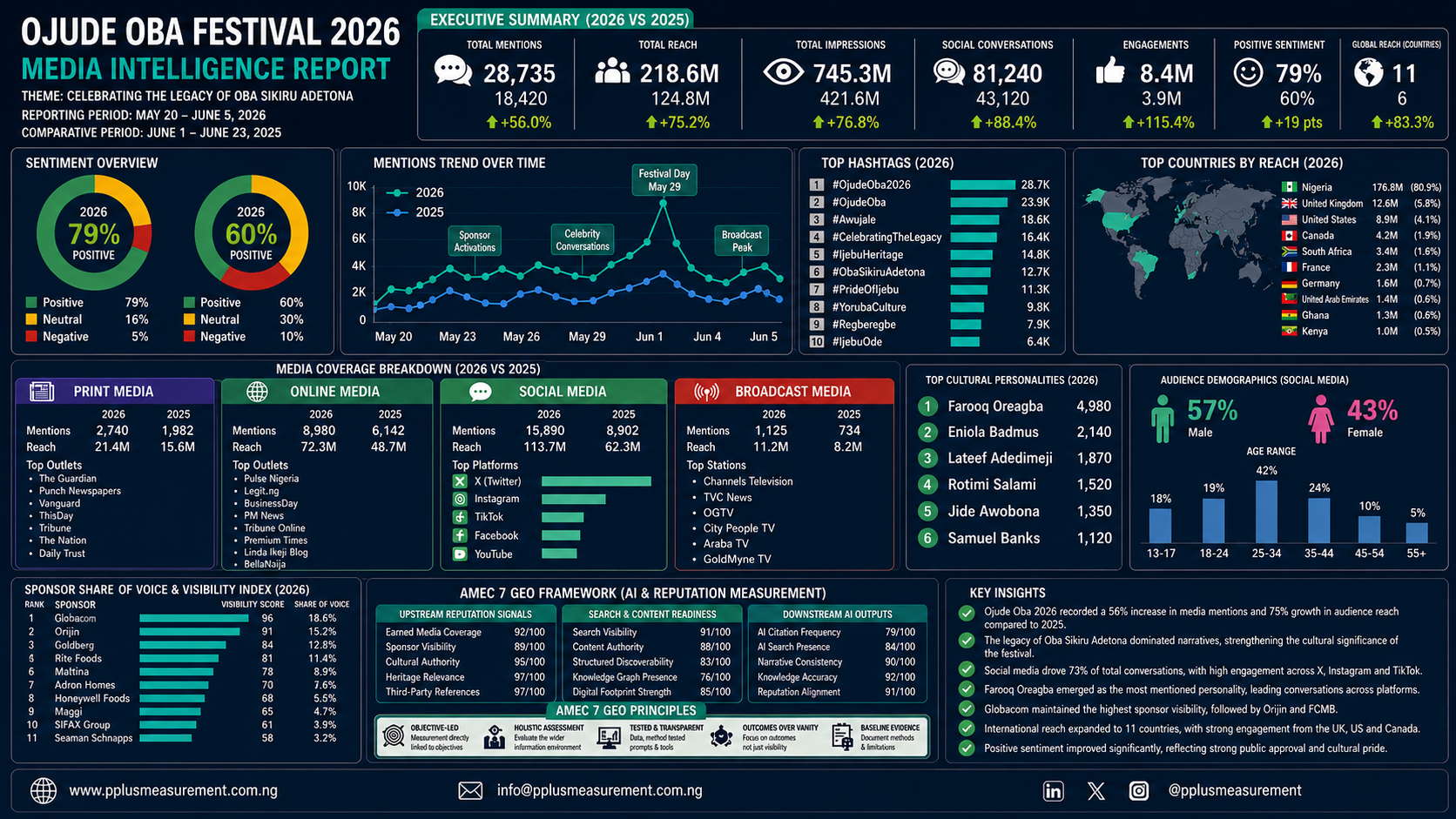
A newly released Media Intelligence Report by P+ Measurement Services reveals that Ojude Oba 2026 recorded its strongest media performance to date, achieving significant growth across audience reach, media visibility, social engagement, international attention and digital discoverability.
The report analysed media conversations and coverage generated between May 20 and June 5, 2026, across print, online, social media and broadcast platforms, while benchmarking performance against the 2025 edition of the festival.
The findings paint a compelling picture of a cultural institution that is not only preserving heritage but also increasingly shaping conversations across modern media ecosystems.
According to the report, total media mentions grew by 56 per cent year-on-year, increasing from 18,420 mentions in 2025 to 28,735 mentions in 2026. Audience reach expanded even more dramatically, growing by 75 per cent from 124.8 million to 218.6 million people globally.
Social media emerged as the primary engine of visibility, generating over 81,000 public conversations during the monitoring period, representing an 88 per cent increase compared to the previous year. Engagements more than doubled, rising by 115 per cent from 3.9 million interactions in 2025 to 8.4 million interactions in 2026.
Perhaps most notable was the improvement in public sentiment.
Positive sentiment increased from 60 per cent in 2025 to 79 per cent in 2026, while negative sentiment declined by half, dropping from 10 per cent to just 5 per cent. The overwhelmingly positive perception was driven by conversations around cultural pride, heritage preservation, fashion, equestrian displays, community identity and the enduring legacy of the late Awujale of Ijebuland, Oba Sikiru Adetona.
The report identified the legacy narrative of Oba Sikiru Adetona as the single most influential thematic driver of media coverage throughout the reporting period.
Unlike previous years, where conversations focused primarily on spectacle and pageantry, the 2026 edition witnessed a deeper engagement with themes of history, leadership, continuity and cultural preservation, elevating the festival beyond entertainment and positioning it as a significant cultural institution.
International visibility also recorded substantial growth.
While Nigeria remained the dominant source of conversations and media coverage, the festival generated measurable attention across the United Kingdom, United States, Canada, France, Germany, South Africa, Ghana, the United Arab Emirates, Kenya and the Netherlands. This expansion contributed to a near doubling of the festival’s global footprint and reflects the growing interest in African cultural experiences among international audiences and diaspora communities.
The report further found that social media accounted for the largest share of total conversations, followed by online news platforms, print publications and broadcast media. Coverage was amplified through extensive reporting by Channels Television, TVC News, OGTV, City People TV, Araba TV and GoldMyneTV, alongside significant digital coverage from leading Nigerian news and entertainment platforms.
Among personalities driving online conversations, Farooq Oreagba once again emerged as the most discussed cultural figure associated with the festival. Other highly visible personalities included Eniola Badmus, Lateef Adedimeji, Rotimi Salami, Jide Awobona and Samuel Banks, whose appearances and social media mentions helped sustain public interest throughout the event period.
Corporate sponsorship continued to play a critical role in the festival’s visibility ecosystem.
Globacom retained its position as the most visible sponsor, followed by Orijin, FCMB, Goldberg, Rite Foods, Maltina, Honeywell Foods, Adron Homes, Maggi, SIFAX Group and Seaman Schnapps. The report notes that brands increasingly view Ojude Oba as a strategic platform for cultural storytelling, community engagement and reputation building.
One of the most significant additions to this year’s report is the application of the AMEC GEO Framework, the newly introduced global measurement model designed to help organisations understand how reputation, content, and visibility influence outcomes in AI-driven information environments.
Using the framework’s three core dimensions—Upstream Reputation Signals, Search and Content Readiness, and Downstream AI Outputs—the analysis assessed Ojude Oba’s performance not only in traditional media but also within emerging AI-powered discovery systems.
The assessment found strong performance across earned media authority, cultural relevance, content visibility, and reputation consistency. The festival demonstrated growing discoverability within AI-assisted search environments and generated strong indicators for future cultural visibility across generative search platforms.
According to P+ Measurement Services, this represents a fundamental shift in how cultural events should be evaluated.
“Media success is no longer defined solely by coverage volume or impressions,” the report notes. “In an AI-driven information ecosystem, discoverability, authority, narrative consistency and reputation signals increasingly determine whether institutions remain visible, trusted and relevant. Ojude Oba’s performance demonstrates the importance of measuring cultural influence through both traditional media metrics and emerging AI visibility frameworks.”
The report concludes that Ojude Oba has evolved beyond its traditional role as a cultural celebration and now functions as a powerful platform for tourism promotion, economic storytelling, cultural diplomacy, national branding and global heritage engagement.
As governments, tourism agencies, brands and cultural institutions seek new ways to compete for attention in an increasingly fragmented media environment, Ojude Oba offers a compelling case study in how heritage can be transformed into measurable influence, sustained visibility, and long-term reputation value.
With record audience reach, stronger public sentiment, expanded international visibility, and growing AI discoverability, the 2026 edition marks a defining moment in the festival’s evolution from cultural event to global cultural brand.
